
The unavoidable consequences of OW participation

This is a guest post by Michael Davidson, who is a father, husband, attorney and active member of the Church.

In a recent Facebook exchange, I was asked to share what in my life would be damaged if women were ordained to the Priesthood. My response was that his question missed the mark. I haven’t opposed Ordain Women (OW) because I think that female ordination would be such a terrible thing. Rather, my opposition to OW is that it is a trap that will lead people out of the Church. A friend responded and insisted that “Mormons are not being led out of the church by OW.… For me and many other Mormons OW and FMH has provided a profound place of comfort and solace within the church.”

This refrain has been repeated many times and in many places by folks from the OW crowd. OW founder Kate Kelly has repeatedly stated that OW is perhaps the greatest retention effort in the Church right now. Most recently, in the “Getting Started” handout related to OW’s new six discussions, OW claims “we have already seen this organization serve as an LDS retention effort for women who left, or were considering leaving, the Church due to their feelings on gender inequality.” OW actively promotes itself as a group who provides a “profound place of comfort and solace within the Church” as observed by my friend. But this is a false claim. In fact, I propose that there is nothing about participation in the OW movement that will strengthen someone’s commitment to the Church. Instead, the natural consequence of participation will be to lead women and men out of the Church.

OW must realize the course they are setting will lead people to have difficult conversations with their Bishops and Stake Presidents. From the very beginning OW has a “Productive Conversations Toolkit” available on their website. The purpose of this document is to prepare OW acolytes to “effectively and confidently engage in conversations with leaders and peers about Ordain Women and the ordination of LDS women.” The document begins by introducing the hypothetical that the reader has “just got called in to meet with your church leaders.” It then gives specific advice for, among other things, avoiding discipline. Why would such a thing be necessary if it weren’t for the fact that it was entirely foreseeable and expected that activity in OW would lead to potential Church discipline or other problems?
Continue reading

‘Really? Wow!’ A discussion of mental illness, disabilities and the Atonement

This is a guest post by Jeffrey Collyer, who says about himself, “Not much to say really. I’m a middle-aged member of the Church, married to a fabulous woman with whom I do my best to raise 4 children, living in the UK. I’ve been writing my own blog about the Atonement for the last 6 months or so – www.allthingswitness.wordpress.com”

This is a subject which I feel is incredibly important, but it is a post I’ve found this a particularly difficult to write, so I hope that a) I can do it some justice, and b) those with particular insights and experience will comment*. It is a subject we rarely discuss, but which I feel we need to gain greater insight into, so that we are better able to comfort those in need.

A few months go I posted a couple of articles on my own blog on the subject of depression, what I consider to be one of the great plagues of our age, and how we can find relief through Christ. Those posts can be found here, and here. While depression is fortunately becoming increasingly discussed in the Church (not enough yet I think, but we’re making some positive progress), other aspects of mental illness or disability are generally discussed either rarely and on obscure internet forums, or (more likely) not at all.

But if Christ suffered for ALL of our pains, sicknesses, and afflictions, that means he suffered also for our mental illnesses and disabilities; it means that through His atoning sacrifice there is power for those suffering. Elder Joseph B Wirthlin said, “No grief is so great, no pain so profound, no burden so unbearable that it is beyond His healing touch.” (Special Witnesses of Christ, Ensign, April 2001). That includes those with Bipolar Disorder, Schizophrenia, and Personality Disorders; and it includes things like Autism, and so many other conditions. Some individuals with these and a host of other mental illnesses and disabilities are amongst the most vulnerable in our society and they, along with those who care for and are very close to them, often suffer intensely through their lives. Surely of those whom the Saviour would wish to comfort most in this life, these sons and daughters of our Heavenly Father are amongst the most precious to Him, and I’ve no doubt that He weeps for their pains and sorrows.

The seeds of my decision to write on this broader issue of mental illness and disability, and the Atonement, probably lie in a meeting I had some time ago with someone who suffered from Bipolar Disorder. The purpose or content of the meeting are not relevant, other than to say that this good man had suffered for many, many years. At one point during the meeting, I felt a prompting to say to him something along the lines of, “Brother………., I want to testify to you that our Saviour Jesus Christ suffered for all of our afflictions and infirmities. And in suffering for them, He also understands them. Christ knows what it is like to have Bipolar Disorder. He understands!”

Well, the reaction of this good man was something I hadn’t expected. He was a religious man already. He already believed in Christ, but now his eyes widened, and he replied in an astonished voice, “Really? Wow!”
Continue reading

Emma’s Ultimatum

[This post is part of a series on Joseph Smith’s Polygamy. To read from the beginning or link to previously published posts, go to A Faithful Joseph.]

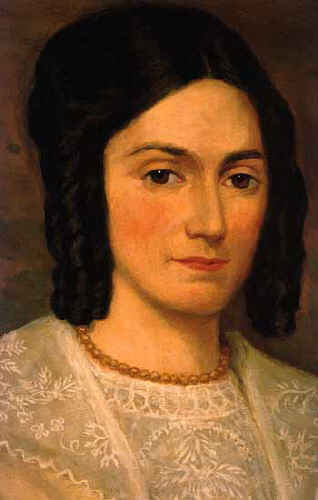
Emm Hale [Smith] circa 1843

Emma Hale had been Joseph’s wife since he was a young, poor man. Since the beginning of their courtship in the late 1820s, Emma was aware of the opposition that faced Joseph, including attempts to physically harm Joseph. Joseph had repeatedly been attacked, beaten, imprisoned, held at gunpoint, betrayed into enemy hands, and returned to her variously bleeding, bruised, tarred, and emaciated.

Eventually she would receive Joseph’s lifeless body, riddled with bullets.

Along with Hyrum, Emma likely believed that Joseph’s teachings and actions related to plural marriage would cause his death, as seen from her vehement reaction to his sermon regarding how the Church might handle converts from countries where polygamy was practiced.[ref]Accounts regarding a fall 1841 sermon mentioning polygamy are recorded by Joseph Lee Robinson, George A. Smith, Horace Cummings, and Helen Mar Kimball [Smith Whitney] document Joseph’s sermon and retraction. Robinson and Kimball mention Emma’s reaction, see Brian C. Hales, Joseph Smith’s Polygamy, Volume I, Chapter 9.[/ref] Yet her silence regarding Joseph’s plural marriages leading up to May 1843 does not mean she was ignorant of Joseph’s activities regarding plural marriage. Continue reading

The Quest for Polygamy in Sunday School

The title might sound strange, but that is what some members of the LDS Church are asking to find. Stories are told about lifelong members not hearing until adult age that Joseph Smith, or even Brigham Young, had practiced polygamy. These are not converts that can be expected to not know the basics of Mormon history. How can this happen? Its really hard to imagine, considering how intertwined Mormonism is with polygamy in popular secular thought. Eventually, sooner than later, a Mormon gets asked how many wives they or their husbands or father has. It becomes an exasperating eye roll question rather than shock. Most of the time. Apparently not all the time and for everyone.

My own experience, I believe, is a typical example of the slow learning about polygamy. Like so many Mormons, the subject just wasn’t brought up in church. Primary was too early where even discussions about reproduction would be inappropriate. The two subjects kind of go together. Most of the time the first inkling of both comes from school peers. At the age of around 10, that was the context of my exposure to the idea within Mormon teachings and history. My non-Mormon friend asked an offhand question if Mormons practice polygamy. I was taken by surprise, and assured him that there were all kinds of rumors floating around about Mormonism. I assume even by that remembered point of my life that I must have heard something before then to say it was one of many falsehoods.

A few years later I find out that Mormonism did indeed teach and practice polygamy, but not from a hostile source. By my mid-teen years I had developed a fascination with Joseph Smith and so grabbed the closest biography I could find. No, it wasn’t Fawn Brody’s famous scholar approved expose. The book Joseph Smith: An American Prophet by John Henry Evans was a rough sketch of his life and contained a small notice of Joseph Smith’s polygamy. The 1933 book stated, “ Polygamy or, as the Mormons prefer to call it, ‘plural marriage,’ was first introduced among the Saints in Nauvoo, in 1841 — although the Prophet had had the idea in mind ever since 1831.” (1966 ed., pg. 271). Again, the confirmation of this didn’t come from a source outside Mormon faith, but A Comprehensive History of The Church of Jesus Christ of Latter-day Saints by B.H. Roberts who was himself a practitioner. He devoted an entire chapter in the second volume of his multi-volume history.

Both books might have talked about polygamy, the latter more than the former, but for completely different reasons. B.H. Roberts treatment aimed to argue that Joseph Smith introduced the practice for the intended audience of the now Community of Christ deniers. John Henry Evans reasoning sought to show that polygamy came from religious convictions. Regardless of why the two talked about it, the point is that Deseret Book published these books openly. Arguably it might be considered white washed treatments, but by no means was it hidden. Continue reading

Book Review: Polygamous Wives Writing Club

HarlineOne of the perks of being a Mormon blogger is the opportunity to comment. Recently I was informed of a new book Oxford University Press will be publishing in June 2014, titled The Polygamous Wives Writing Club: From the Diaries of Mormon Pioneer Women, by Paula Kelly Harline.

Ms. Harline assembles stories of twenty-nine women who entered into polygamous marriages between 1847 and 1890. Ms. Harline wished to show the lives of regular women who remained faithful to Mormonism yet were not leaders themselves or wives of leaders. Continue reading