Discussion Two Critique

Discussion2In this second discussion we are asked to to know the history. What follows reads like a graduate level analysis of historical points. I would argue they don’t sufficiently know the background behind the history they cite, but there are many good points here.

I would note that I’m the one of all of us women here that actually has talked about giving blessings by my faith in Christ. These blessings that I’ve voiced have been few, like seriously few. I almost always ask someone who holds the priesthood to voice blessings. But I know I can bless, and have done so.

There are four components to this discussion:

1) The Relief Society Minutes, where a) Emma is given the right to preside (a surprise to younger Mormons); b) Joseph talks of making the Society a kingdom of priests as in Enoch’s day, as in Paul’s day; and c) Joseph explicitly talks about women giving healing blessings and casting out devils.

2) A paper by Linda King Newell in the Silver Edition of Sunstone tracing the history of the migration from Joseph’s teachings regarding blessings and today’s practices where folks presume it is forbidden due to Joseph Fielding Smith’s memo to Belle Spafford in 1946, where he says the authorities have ruled washing and anointing the sick by women is permissible, but they think it is better to send for the Elders.

3) Greg Prince’s delightful interview of Chieko Okasaki published in 2012 (Dialogue).

4) A 15-minute video about women and the priesthood that speaks to various things, including how the once-independent assets of the Relief Society were absorbed by the Church.
Continue reading

Discussion One Critique

Discussion1I’ve been interested in reviewing the discussions those critical of the Church’s treatment of women promised to post. My experience is that you really had to dig to find this stuff.

Looking at the first discussion, “See the Symptoms,” I find I agree with much of what they are saying. Basically, the lesson talks about what it is like living in a culture where one portion of the participants are not treated equitably. I have experienced inequitable treatment as a woman in a male-dominated profession and as a mixed-race child engendered at a time and place where my parents’ marriage was consider void and prohibited. I get the importance of equitable treatment. However their conclusion that disparities between the males and females in congregations would evaporate if only women were permitted priesthood ordination seems simplistic and flawed.

Continue reading

Revealing the Revelation

[This post is part of a series on Joseph Smith’s Polygamy. To read from the beginning or link to previously published posts, go to A Faithful Joseph.]

William Clayton, Joseph’s Scribe

Despite all that had happened through the end of June 1843, Joseph had never written down the revelation regarding plural marriage. Nor had Joseph spoken publicly about the doctrine involving possible plural marriage.

That was about to change.

Emma had demanded something of Joseph in June 1843. In response, Joseph had packed up Emma and the children and traveled some 200 miles northwest to the home of Emma’s sister, Elizabeth Hale Wasson. The pressures of Church leadership and the women Joseph had covenanted with were left behind in Nauvoo.

We’ll never know how long Joseph intended to remain with the Wassons. Sheriff Reynolds of Jackson County, Missouri, and Constable Wilson, of Carthage, Illinois, came to arrest Joseph, pistol-whipping him and tearing him away from Emma in a scene reminiscent of the horror at Far West, when Joseph was dragged to prison and his family was thrust from him by the sword.

By the beginning of July, Joseph was back in Nauvoo, protected by the strong city charter Dr. Bennett had crafted. Emma’s relief was short-lived. She was once back in Nauvoo, with all the stresses and individuals that had caused her grief the month before. She had made a demand of Joseph, which God had commanded Joseph to grant her. She planned to campaign until her promised relief was granted. Continue reading

Why missionary work isn’t working

Other working titles:
1. Flooding the Earth with the Book of Mormon Musical
2. And Now a Word from Someone Else’s Sponsors

When I was a missionary 35 years ago, we were excited that President Kimball could announce reaching 30,000 missionaries.  We were also excited to be baptizing 250,000 or more people a year. In fact, we had a couple years that reached 300,000 new converts.

Now in 2014, we are excited to say we now have over 85,000 missionaries – almost 3 times when I was a missionary!  Not only that but we are now baptizing an astonishing….250,000 new converts per year? Continue reading

Women and the Restoration of the Priesthood

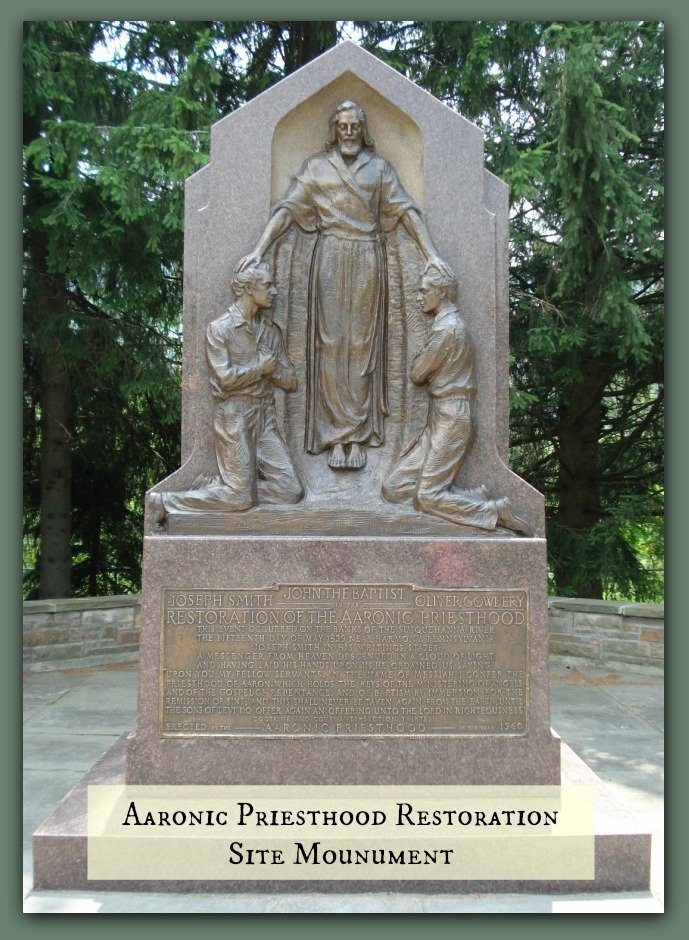
Today is the 185th anniversary of the restoration of the Aaronic Priesthood. The introduction to Doctrine & Covenants 13 states:

“The ordination was done by the hands of an angel who announced himself as John, the same that is called John the Baptist in the New Testament. The angel explained that he was acting under the direction of Peter, James, and John, the ancient Apostles, who held the keys of the higher priesthood, which was called the Priesthood of Melchizedek. The promise was given to Joseph and Oliver that in due time this higher priesthood would be conferred upon them.”

AP restoration 1 finished

John the Baptist pronounced the following blessing:

”Upon you my fellow servants, in the name of Messiah I confer the Priesthood of Aaron, which holds the keys of the ministering of angels, and of the gospel of repentance, and of baptism by immersion for the remission of sins; and this shall never be taken again from the earth, until the sons of Levi do offer again an offering unto the Lord in righteousness.”

With the restoration of the Aaronic Priesthood and a short time later, the Melchizedek Priesthood, the world was changed forever. Man again had the authority to perform ordinances essential for salvation for all mankind, and the door was open for the further restoration of priesthood keys.

A few years ago, my husband and I had the chance to visit the Church Historical sites in the eastern United States. We pulled off the highway and stopped at the Aaronic Priesthood Restoration Site. It was not a big place, nor was there a visitor center or name-tagged missionaries there to greet us. There were just some signs explaining what had happened there, and the foundation stones of the Smith cabin. Nearby was the cemetery where Emma Smith’s parents and Emma and Joseph’s first baby are buried. Despite the simple setting, the spirit at this site was very powerful. My husband and I hopped a fence and crossed a rail road track and managed to make our way down to the banks of the Susquehanna River. It was beautiful, reverent and the perfect setting for such an important event. The Holy Ghost testified to both of us of the power and importance of the priesthood and of vital importance of its restoration.

These days there is much chatter and discussion about the priesthood in the Church. The leaders of our church have taught us many times over the years about what the priesthood is, about who may exercise its keys and how all members of the church are entitled to access its power.

In his most recent General Conference address, Elder Dallin H. Oaks of the Quorum of the 12 spoke about The Keys and Authority of the Priesthood. In this talk he made some key points that clear up the confusion and contention that cloud discussions on the priesthood. Continue reading