
It turns out that religion can help unhappy people be more happy and find meaning in their lives. Who would have guessed it? For many decades, apparently not the field of psychology. But, according to this article, that is changing.
For anyone who took a college course in psychology more than a decade ago or who is even casually acquainted with the subject through popular articles, a close examination of today’s field would undoubtedly prove surprising. The science that for most of the 20th century portrayed itself as the enlightened alternative to organized religion has taken a decidedly spiritual turn.
Bowling Green State University professor Kenneth Pargament, who in 2013 edited the American Psychological Association’s Handbook of Psychology, Religion, and Spirituality, notes just how dramatically his profession’s attitude towards faith has changed in recent times. As a young academic interested in the connection between mental health and religion, he would “go to the library once a semester and leisurely review the journals” only to be disappointed by how little his colleagues had to say about it. But “no more,” Pargament happily reports. In fact, he adds, “it is hard to keep up with the research in the field.”
Today’s psychology tells us that faith can be very helpful in coping with major life setbacks, including divorce, serious illnesses, the death of a loved one, and even natural or human-caused disasters. A study by the RAND Corporation, published in the New England Journal of Medicine just after the 9/11 attacks, found that 90 percent of Americans coped with the trauma by “turning to God.” During the week that followed, 60 percent went to a church or memorial service, and sales of the Bible rose more than 25 percent.
Other studies have shown that religious people are less prone to depression and anxiety, are less likely to abuse alcohol and drugs, and have above average immunity to physical diseases. As a result, psychologists are now developing faith-based approaches to treating chronic anger and resentment, the emotional scars of sexual abuse, and eating disorders.
As a convert to the Church of Jesus Christ of Latter-day Saints, I can attest that I am much happier now than before my conversion. So, it is encouraging to see my experience — and the experiences of so many other people I know personally — being validated.
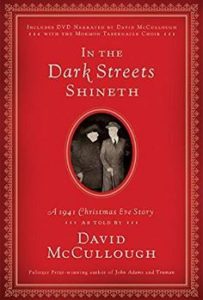 One of my favorite books of all time is “In the Dark Streets Shineth: A 1941 Christmas Story” by David McCullough. It’s a short book and mostly pictures, but it tells the story of Christmas 1941, right after the US had been attacked at Pearl Harbor. It was a very dark time in our nation’s history. This book also tells the story of how the Christmas hymn, “O Little Town of Bethlehem” came to be and how that song, written in the 1850s, had a part in the Christmas of 1941. I think I also want to nominate David McCullough to narrariate the Ken Burns 9 part documentary on my life (haha).
 Happy Sabbath! The perfect Christmas music for today is Handel’s Messiah. These are just a few of the selections from the First Movement, which talks about the prophecies of Christ’s birth and the miracle of His birth. I have many happy memories of singing the Messiah at Christmas and Easter times — in our stake choir growing up, and in college. A few years ago we had a Messiah sing-a-long here in my very small Northern New Mexico town. The choir and orchestra were made up of people from all over the community. I was blown away by the level of talent in our little town. For me singing the Messiah — whether it’s in a choir, or just singing along to youtube videos — never fails to uplift my spirit and helps to sink into my soul the love our Heavenly Father has for us, and how the birth of our Savior is a true miracle.
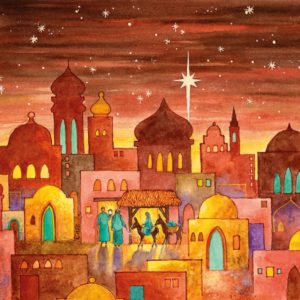 In Luke 2:4 we read, “And Joseph also went up from Galilee, out of the city of Nazareth, into Judæa, unto the city of David, which is called Bethlehem; (because he was of the house and lineage of David:)” Bethlehem means house of Bread. It’s fitting that Christ, who proclaimed himself as “the Bread of Life” was born there.