
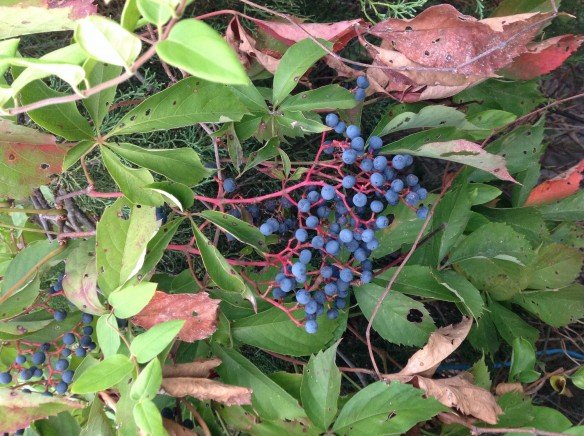
The Deaths of the DeLongs: Searching for Blue Berries

image
In October 1845, during the height of the Mormon persecutions in Illinois, four of the nine members of the DeLong family died. The DeLongs were impoverished converts who arrived in Nauvoo in time to join the lines to view the dead bodies of Joseph Smith and his brother Hyrum. After the parents and two children died, the rest were scattered. Of these, only one ended up traveling west as far as Utah. That four-year-old in a red flannel diaper and a straw hat would go on to be one of the first settlers of Panguitch, Utah.

I had heard as a youngling about how a neighbor had provided blueberries, from which Mother DeLong prepared a pie. But most of the children refused to eat the pie. Those who did, both parents and one son, all died of ague, violent illness. Mother DeLong gave birth the day her son and husband died, and both she and the new infant died soon thereafter.

The problem with the story was that blueberries have a very short season: in Illinois they are only available in July and August. Other members of the extended family criticized the oral history from the surviving family members because it didn’t agree with written records from this terrible time and the fact that Mother DeLong didn’t die the same day as her husband and son.

My personal experience as a pregnant mother taking lethal levels of drugs (in my case to treat the heart condition of my unborn son) helped me understand why a poison migh induce labor but not immediately kill.

That left only the identification of poisonous blue berries that could be mistaken for blueberries in early October in Illinois. I have been searching for a possible candidate berry for over a decade. Continue reading

Grading the Pope’s visit so far

Pope Francis is visiting the United States, and he is proving to be one of the most controversial popes of recent times. This is not a bad thing. But the Pope’s grades are are mish-mash: he gets some As and Bs but also a lot of Fs and Incompletes. Let’s take a look.

Dining with the homeless rather than with Washington politicians. A-PLUS. Did Jesus spend his time with the Sanhedrin and Pilate, or did he spend his time with the poor, sick and needy? You know the answer. The Pope leads by example here, and this decision alone makes his trip a success.

Condemning abortion. B. The Pope could have done more to specifically condemn government funding of abortion, but he is sticking to traditional Catholic teaching on abortion, and I think this is mostly a good thing. Of course, the Mormon position is somewhat different on abortion, but the Pope’s reminder that abortion is something to be avoided is a good moral lesson for us all.

Emphasizing the traditional family. A. The Pope gets excellent marks for pointing out that the family is under attack by the secular world. The Catholic church continues to oppose same-sex marriage even though such a view is not popular in Europe and the United States. News flash to liberals: same-sex marriage is still not very popular in many areas of Latin America, Asia and Africa, where the Catholic church is growing the fastest.

Emphasizing the importance of religious liberty. A. The Pope told President Obama that Catholics are concerned about maintaining religious liberty in the United States. Good for him. We should all be more concerned about this.

Compassion for immigrants. B. The Pope gets solid grades for his Christ-like love of immigrants, but the refugee crisis in Europe is not a simple problem that can be solved by Europeans blindly taking in millions of mostly Muslim people, the majority of whom are motivated by economics. Yes, the United States is a land of immigrants, but the United States also takes in millions of immigrants every year, and as much as I believe in the benefits of immigration it must be done in an orderly fashion with clear knowledge that many immigrants do indeed end up getting benefits from the government. The Pope seems not to care about this reality.
Continue reading

Book Review – “Evolving Faith: Wanderings of a Mormon Biologist”, by Steven L. Peck

Book Review – “Evolving Faith: Wanderings of a Mormon Biologist”, by Steven L. Peck


Maxwell Institute’s newest volume from the Living Faith series is scheduled to be released the end of October 2015.  The author, Steven L. Peck, is an associate professor of biology at BYU and is trained as an entomologist.

I wasn’t sure what to expect of this book, as it seems the Living Faith series appears to be somewhat eclectic, such as Adam S. Miller’s excellent book, “Letters to a Young Mormon.”  And “Evolving Faith” is an eclectic book, as Peck ranges widely in several essays from science to personal musings on death and nature. Continue reading

The Passing of Elder Richard G. Scott

ScottThe Church has just announced the passing of Elder Richard G. Scott today. Our hearts, prayers, and condolences are with the Scott family, as well as the members of the Quorum of the 12 and First Presidency.

His passing marks the third member of the 12 to pass away since April General Conference. This upcoming Conference will give us all the chance to see how the mantle of responsibility is passed to the next, new apostles and to witness the Gospel in action. It’s a testimony to the order the Lord has established in His Church.

Till we meet again, Elder Scott. Thank you for your years of wise council and wisdom. You will be missed.

UPDATE: Elder Scott’s funeral will be held on Monday, September 28, 2015, in the Salt Lake Tabernacle at 11am MDT. The funeral will also be streamed online at LDS.org, MormonNewsRoom.org, BYUTV.org and on KSL, and KBYU tv in Utah.

Towards a Book of Mormon Study Edition

This is a guest post from Jamie Huston, who blogs at Gently Hew Stone. Jamie describes himself as “yet another world music / Criterion Collection / Hudson River School / camping / genre fiction-loving libertarian Mormon English teacher. And father of 7.”

____________________________________________

I love a good study Bible. Earlier this year I found a nearly new NIV Archaeological Study Bible on sale at a library for a dollar—a 98% savings off the cover price!—and I’m getting a lot of mileage out of it.

I’ve been thinking about study Bibles a lot after reading Bill Hamblin’s much-needed rant about the demise of Book of Mormon studies at BYU, such as it ever was. At one point, he summarizes what’s missing in the curriculum:
Most simply, BYU could offer in depth courses on each of the major books of the Book of Mormon, combining some of the smaller books into one. Note that Religious Education offers a class on Isaiah, but no class on the book of Alma or Helaman or Nephi?

Why?

Beyond in depth classes on major books of the Book of Mormon, BYU should offer classes on Book of Mormon geography, history, archaeology, linguistics, literature, theology, culture, language (ancient Near East and Maya), textual criticism, religion, law, warfare, apocalyptic, reception history, the Bible in the Book of Mormon, etc.

He’s clearly right, of course, but I want to suggest another avenue besides BYU classes for improving Book of Mormon studies among Latter-day Saints.
It’s time we have a decent study edition of the Book of Mormon. Continue reading