Recently, scholar Andrei Orlov* uploaded a paper to Academia.edu, entitled “The Curses of Azazel”. In this paper, Orlov uses the ancient document, Apocalypse of Abraham, to discuss the scapegoat of Yom Kippur, the Festival of Atonement. His excellent article made me think of how such issues may also be found in the Book of Mormon. I will discuss it momentarily, after a brief introduction to the Festival of Yom Kippur and some other important issues to consider.
Yom Kippur
During Yom Kippur, the high priest performs very important functions. Among these ordinances, is entrance into the Holy of Holies (the only time during the year it is entered), sanctifies the instruments and Mercy Seat, and utters the sacred and ineffable name of God, “YHWH”. As he enters the Holy of Holies, he wears a special priest garb, which includes a turban/mitre, a sash, and the robes. On his robes are bells, which tinkle as he moves, so those waiting outside for him can listen in and ensure he is still alive. If the high priest enters unworthily, God would strike him dead, and the silence of the bells would tip off his assistants to pull his body out by the rope attached to him for such an event. On the turban, one finds the name of “YHWH”. It is the unspeakable, ineffable name. Only the high priest knew the correct pronunciation. Some of his assistants would know portions of the pronunciation, but not all, so that at the death of the high priest, the assistants could each whisper their portion of the Name into the ear of the newly chosen high priest, allowing him alone to then know the full pronunciation. The Name, as Orlov notes in his article, is extremely important. To have God’s name was to have his power to create, destroy, or perform miracles. Orlov notes from several ancient texts of fallen angels, or Watchers, who found out the Name and misused its power on the earth, causing them to be rejected by God.
One of the other major events in Yom Kippur, is that of the two goats. Two goats are chosen and brought before the high priest. One will be the sacred sacrifice, given to God. For Christians, this represents the sacrifice of Jesus by his Father. The other goat, known as the scapegoat, also has an important role to play. The high priest, prior to dressing in his temple robes, pronounces the sins of the people. Laying both hands on the head of the goat, he transfers those sins from Israel to the goat. A crimson wool thread is placed on the head of the goat. The goat is then sent into the wilderness, although some ancient texts show that it is pushed off a cliff, where it dies in a wilderness area. Those who lead the goat to the wilderness/death, then are to wash their clothes and become clean again from touching that which is unclean. Tradition has it that the scarlet thread became white, once the scapegoat was dead. Orlov suggests that this directly ties in with Isaiah’s initial plea to Israel:
Wash you, make you clean; put away the evil of your doings from before mine eyes; cease to do evil; Learn to do well; seek judgment, relieve the oppressed, judge the fatherless, plead for the widow. Come now, and let us reason together, saith the Lord: though your sins be as scarlet, they shall be as white as snow; though they be red like crimson, they shall be as wool. (Isa 1:16-18)
With this ordinance, the nation of Israel is absolved of its sins once a year. For early Christians, both goats represented different aspects of Christ’s life: the sacrificial goat and the one who takes upon himself all the sins of the people.
Continue reading →

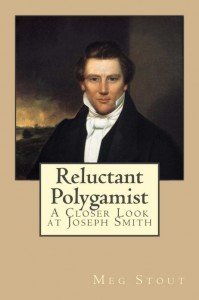 This week the Advanced Review Copy of Reluctant Polygamist will disappear from Amazon.com.
 Going to the temple is about more than the ritual and theological discourse. They are of course essential, because without them there would be no temple experience. Yet, the only reason a believer can return is out of obligation to people who have died. That means researching genealogy. Preferably the LDS Church leadership wants us to locate our own ancestors. Spiritual and temporal blessings can accompany the process of searching, locating, indexing, and doing the temple work for deceased individuals. The more involved at the start, the greater the satisfaction. For some it gives the same feeling as helping a living person become converted to the gospel.