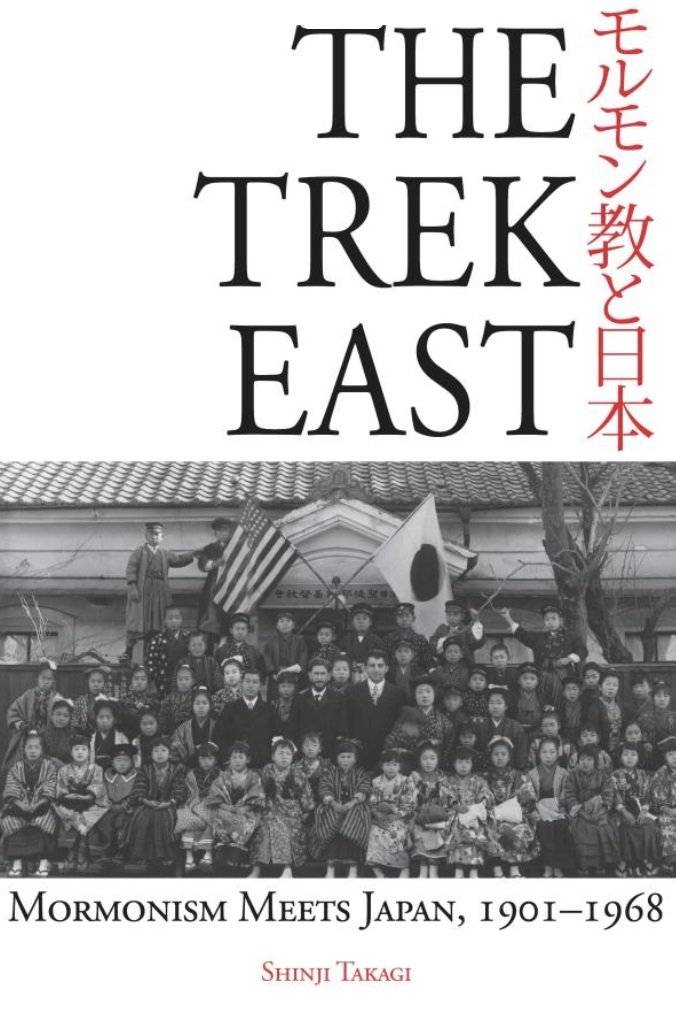
 In The Trek East, Dr. Shinji Takagi has produced a masterful treatment of Mormonism’s foundation in Japan. Dr. Takagi takes an approach that informs us of Mormonism in Japan in a manner that focuses on inputs and results, environmental conditions in Japan and cultural biases of a Mormonism informed by western assumptions.
Mormonism arrived in Japan at the first possible opportunity, yet at the worst possible time. Westerners were ignorant regarding Japan and unconscious prejudice against non-whites manifested in scant resources initially devoted to the Japan Mission. Yet the Mormon presence in Japan has blossomed based in no small part on early actions and decisions that contemporary peers felt were misguided.
I am delighted by this book for several personal reasons. First, Brother Takagi was my family’s home teacher when I was a teenager in the DC area. Second, I see this history of the Church in Asia through the lens of being a daughter of the first missionary convert in Taiwan. Finally, my work in recent years has involved significant travel to Japan, so the history and geography described in this book are somewhat familiar to me.
The Trek East is nearly 600 pages long, of which the primary text comprises 440 pages organized into 12 chapters. Each chapter can be read as a stand-alone work. Yet reading the entirety of the work produces a synergistic level of understanding that is not achieved by solely considering chapters in isolation.
Below I give a broad overview of the structure, but I cannot do justice to the gems that are scattered throughout this extensive work. Dr. Takagi’s economic background produces a respectful and rational discussion of the cost individuals pay to accept Mormonism or any new belief system, which ultimately undergirds the growth of any organization of individuals. For example:
The “characteristics of early Mormon converts are consistent with what has been observed in other cultural contexts among various [ideological] traditions… The cost of conversion is expected to be lower for someone who is already a Christian and can therefore use part of the same human capital [already invested in their prior Christian system of belief.]
“[A] younger person is likely to possess a smaller stock of capital… the cost of giving up the current religion… is smaller [and] the benefit of switching to a new religion will be enjoyed over a longer period, making its expected net present value greater.” [ref]Shinji Takagi, The Trek East: Mormonism Meets Japan, 1901-1968, Greg Kofford Books, Salt Lake City, 2016, pp. 131-132.[/ref]
This informs my understanding of my own history, where my young father and his two siblings embraced the gospel in Taiwan in the late 1950s, prepared by the Christian faith of their mother. Similarly, such “macro” level explanations can help us see our own day, when ideologies such as unbelief and gender-agnostic sexual liberalism are claiming some of our youth. Continue reading →

 Review of Let Your Hearts and Minds Expand by Thomas F. Rogers.