Grading Trump’s first year

Back in May 2016, I predicted Trump would win the presidency.  You can read my prediction here.  If I do say so myself, my prediction was spot on, not only the prediction that Trump would win but the reasons he would win.

The other point I made in the article was that when it came to policy Trump is not that much different than Mitt Romney.  And, again, that prediction has pretty much come true (with important caveats — keep on reading).

I have to admit, I love being right.

So, here we are nearly at the end of 2017, and the question is:  how has Trump done?

To summarize:  when it comes to policy, he gets a solid B.   When it comes to demeanor, personal moral leadership and generally being presidential, Trump gets an F.

I am of the school that policy is more important than demeanor and personal moral leadership, so I must say I am mostly happy with Trump’s first year.  (Note the word “mostly.”)

Here are the specific grades:

Continue reading

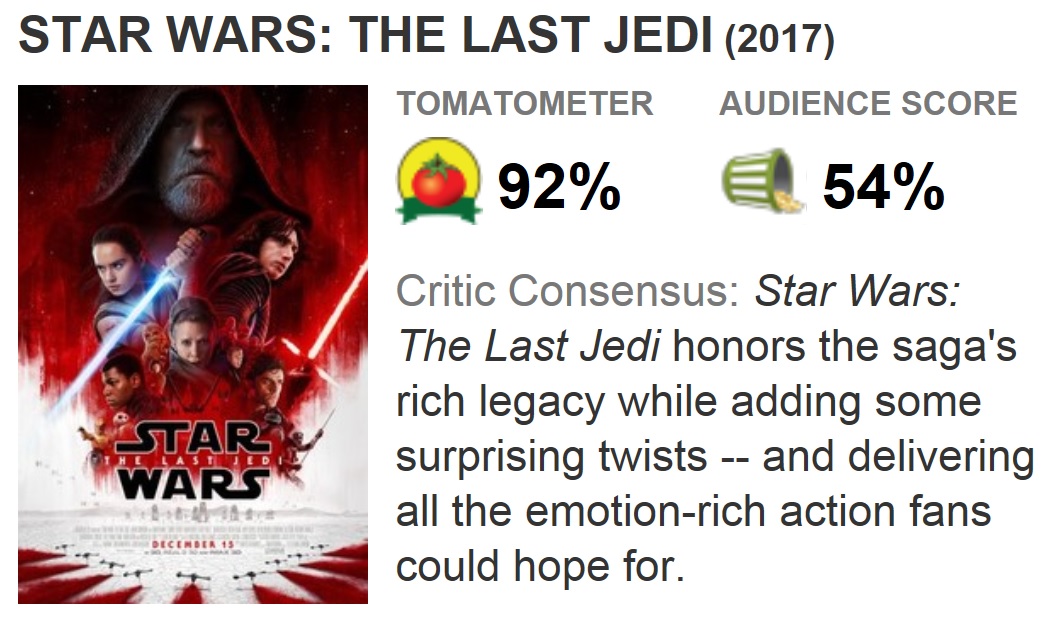
Reviewing The Last Jedi

Someone got busy and used bots to drag down the audience rating for the most recent Star Wars film. Alt right folks are claiming credit, suggesting that men should rule rather than women.

It’s not clear that the Alt right folks actually did the deed.

If you like sci-fi and are looking for something to do this weekend the Last Jedi is worthy of consideration.

But if you leave the theatre wondering why you don’t quite feel satisfied, click through to read my analysis. Warning, my analysis contains spoilers. Continue reading

LDS Perspectives: In the Beginning, with Ben Spackman

December 20, 2017: Genesis 1 – Ben Spackman

[Transcript]

Ben Spackman talks with LDS Perspectives about what scholars believe about the Genesis creation accounts, of interest because of how scholarly research informs our understanding of the LDS creation accounts found in Moses (June 1830), Abraham (1835, published 1842) and the temple (May 1842). Ben is writing a book on the creation accounts tentatively titled Reading Scripture, Reading Creation: The Ancient Context of Genesis 1.

Benjamin T. Spackman has a Bachelor’s Degree in Near Eastern Studies from BYU. He then received a MA and did further PhD work in Near Eastern Languages and Civilizations (Comparative Semitics) at the University of Chicago, where he was a Hugh Nibley Fellow. He has been an Institute teacher for over ten years and has taught at BYU.  Ben blogs at Times & Seasons, and writes Gospel Doctrine background posts at Benjamin the Scribe.

The Morality of Age

An announcement was released by the LDS Church that young Priests can officiate baptisms and girls assist in ways adult women do in the temple. Most discussion about this predictably is about the different roles girls and boys have related to the Priesthood. Another issue pretty much ignored is how age determined what could be done or not in the first place. The reasoning for the change is that Priests have the right and responsibility for baptism, and that should extend to the temple ordinance. What that doesn’t answer is why these were not in effect long ago. More than likely it was because of age and maturity perception.

Choices about age permissible actions are common in both religion and secular society. Like many things the two are at odds in some circumstances. A few vocal critics insist anyone under a perceived adult age should not be taken to a particular church, much less initiated. For some religions the age of marriages should be up to the parents and ecclesiastic leaders, and not a soulless government. Difference in opinion can go both ways with one side believing a person must be older and another a younger age is acceptable. How the ages are decided may seem at times logical, but the laws and edicts when given a closer look seem arbitrary.

The argument for ages is often dependent on a belief that the young are not capable of deciding for themselves. Cognitive abilities for understanding the consequences have not developed enough to make intelligent choices. Although there is some science to back this up, the exact age when a person can be considered mature enough is wildly inconclusive. Studies indicate anywhere from about 10 to the unbelievable 25 before the brain is fully matured. Much of this difference is based on what the study is trying to discover. It could be language acquirement, ease of learning new material, ability to make logical inferences, and more. What they don’t do is ask when a person gains a moral center for independence. That is what most laws and codes of conduct rely on for determining age permissions. Yet, it is the most vague evaluation. Continue reading

LDS Perspectives on the Bible and Documentary Hypothesis

December 13, 2017: The Documentary Hypothesis with Cory Crawford

[Transcript]

Dr. Crawford talks about the reason Julius Wellhausen proposed the first five books of the Old Testament (the Pentateuch or Torah) was a compilation of multiple sources due to the contradictions between the text and itself. Wellhausen in his documentary hypothesis identified four sources: a source that focused on God as Jehovah (J), another that focused on God as Elohim (E), a Priestly source that was aware of both the J and E sources, and the Deuteronomists (D). Though other explanations for the Pentateuch have arisen, no modern scholars adhere to the prior assumption that the Pentateuch consisted of five books written by Moses, himself. It is believed the J, E, P, & D sources were combined into the current Torah format circa 1000-500 B.C.

Though not explicitly discussed in this interview, it is interesting to consider the Book of Mormon narrative that portrays a Torah variant being contained in the brass plates in the custody of Laban. It is also interesting to consider the Book of Mormon explanation for itself as originally an edited compilation of multiple documents, including parallel accounts (e.g., the narrative reported to be in the lost 116 pages versus the narrative contained in the small plates of Nephi).

Dr. Cory Crawford holds a PhD from Harvard in Near Eastern languages and civilizations and currently teaches Classics and World Religions at Ohio University in Athens, Ohio. Dr. Crawford wrote “Competing Histories in the Hebrew Bible and in the Latter-day Saint Tradition” in Standing Apart: Mormon Historical Consciousness and the Concept of Apostasy.

Recent related LDS Perspectives podcasts include Dr. Barlow’s An Introduction to Higher Biblical Criticism with Philip Barlow (aired Dec 6, 2017), Julie M. Smith on Mark’s Human Portrait of Jesus (aired Oct 25, 2017), and Benjamin Spackman’s Misunderstanding the Bible. Julie Smith, in particular, gives us insight into the purpose and raw power of the original “gospel” upon which Matthew and Luke built their more well-known narratives. After Christmas, LDS Perspectives will be airing another podcast with Benjamin Spackman, discussing the different creation accounts (and incidentally suggesting why the current Torah/Pentateuch ought to be understood as arising during the Babylonian captivity, after the timeframe when Lehi and his family would have separated from the mainstream Israelite population).