
Learning from the hippies

A friend of mine posted this on Facebook today, and I thought I would borrow it:

Just overheard on the “Hippie Peace Freaks” message board:
“Life becomes easier when you learn to accept the apology you never got.”

Just consider how in line this is from the counsel from Elder Bednar:

When we believe or say we have been offended, we usually mean we feel insulted, mistreated, snubbed, or disrespected. And certainly clumsy, embarrassing, unprincipled, and mean-spirited things do occur in our interactions with other people that would allow us to take offense. However, it ultimately is impossible for another person to offend you or to offend me. Indeed, believing that another person offended us is fundamentally false. To be offended is a choice we make; it is not a condition inflicted or imposed upon us by someone or something else.

In the grand division of all of God’s creations, there are things to act and things to be acted upon (see 2 Nephi 2:13–14). As sons and daughters of our Heavenly Father, we have been blessed with the gift of moral agency, the capacity for independent action and choice. Endowed with agency, you and I are agents, and we primarily are to act and not just be acted upon. To believe that someone or something can make us feel offended, angry, hurt, or bitter diminishes our moral agency and transforms us into objects to be acted upon. As agents, however, you and I have the power to act and to choose how we will respond to an offensive or hurtful situation.

Choosing NOT to be offended may be the most powerful thing you can do. It strengthens you and helps you concentrate on things that are truly important. Imagine how much better the world would be if all of the people who get offended all the time simply learned to let things go. And if we need to follow the advice of the hippies and pretend that the person who offended us has apologized, and we have accepted the apology in our hearts, so much the better.

Discovering the Sacred in the Temple

This is a second in a series about learning how to get the most out of the Temple.

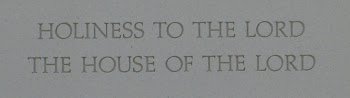
Week 45 019 holiness (2)

Years ago I first entered the Temple as an emerging adult about to enter the mission field. Although many memories of that experience are vague, some thoughts and feelings have not been forgotten. No matter how much information I was given, none of it prepared me for the first time. It was strange to see and participate in such a richly symbolic activity. This left me confused once finished. Despite those who express spiritual rejuvenation and enlightenment, some never return.

Lack of preparation is not the only reason for a negative reaction. Many cultures have unique and demanding rituals that bridge the gap between the child and adult world. Such initiations have mostly been wiped out in Western civilization, replaced by childish giving in to base instincts. What used to be signs of adulthood in the modern culture at least thirty years ago is quickly fading. No longer can marriage and entering the workforce be counted on as expectations. Growing up has been replaced by holding on to adolescence and immaturity for long as possible.

Is it any wonder those who have never entered the sacred walls of the Temple for the endowment can be stunned? Schools teach science, mathematics, and language arts directly. Peripherally social instructions come from peers of the same general age and maturity. For Mormons, church attendance teaches the basics of Faith and Obedience with only a hint of ritual through baptism and Sacrament. The granting of Priesthood and young women awards have some notion of social graduation. Receiving the endowment is the ultimate religious expression of reaching adulthood and spiritual maturity.

My response to discomfort for the first time could have been to never return. There are those who choose this path. Such is not my nature when confronted by things I don’t understand. The need to know inspired me with the willingness to search, pray, and ponder for meaning. Knowing what I do now, I would like to leave some suggestions how to get more out of Temple attendance. Continue reading

High divorce rates among conservative Protestants. What about Mormons?

map_conservative_regional_divorce

The above map is based on a study that appears to show a pretty strong correlation between conservative Protestants and divorce. The study’s authors look at some possible causes and come to the conclusion that:

Unpacking these variations, Glass and Levchak found that the high divorce rate among conservative religious groups is indeed explained in large part by the earlier ages at first marriage and first birth, and the lower educational attainment and lower incomes of conservative Protestant youth.

Explains Glass, “Restricting sexual activity to marriage and encouraging large families seem to make young people start families earlier in life, even though that may not be best for the long-term survival of those marriages.”

Now we Mormons restrict sexual activity to marriage and encourage large families, yet the map seems to show that divorce rates are pretty low (relatively) in heavily Mormon counties of Utah and Idaho. The entire study has not come out yet. I am interested in seeing if the authors considered conservative Mormons at all. I will email this link to the study’s authors and see if I get anything back.

Comments?