
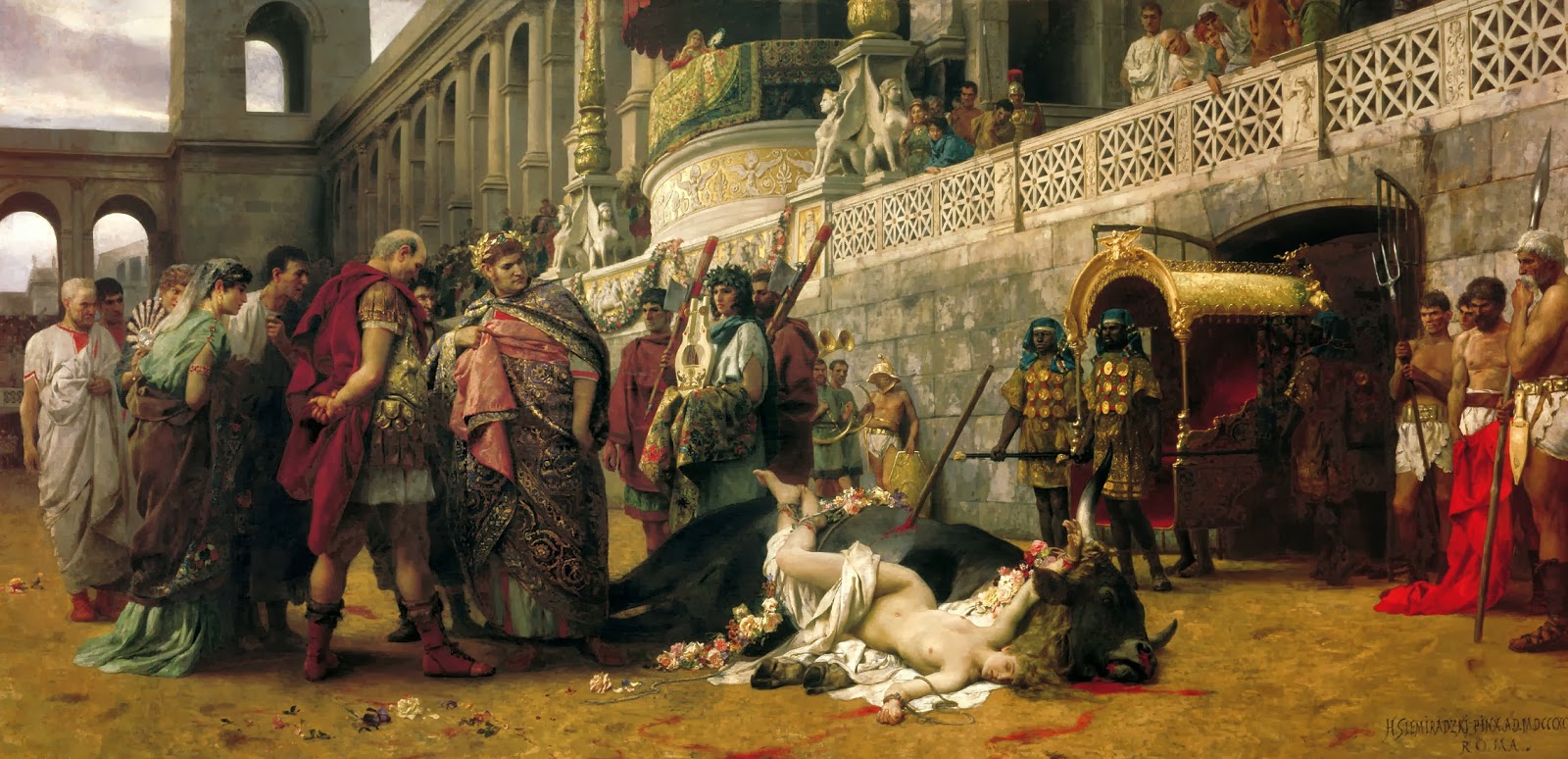
Metaphorical martyrdom

proxy
Henryk Siemiradzki (1843-1902)
Christian Dirce*
oil on canvas, 1897
National Museum Warsaw

This is a guest post by Reid Litchfield, who is an endocrinologist from Henderson, NV. He says he is blessed with a wonderful wife and three great kids. He blogs at http://stunnedbanana.blogspot.com.

Tertullian was born the son of a Roman Centurion in Carthage around 150 AD. As a member of a higher social class, he received an excellent education and was trained as a lawyer. He indulged in all the trappings of his day, including the pastime of watching gladiatorial combat and games where criminals were tortured or eaten alive by wild animals. Historian Roger Pearse, curator of the Tertullian project, said:

. . . among the sights he saw, was that of Christians being executed this way. He was struck with the courage with which stupid and contemptible slave men and little slave girls faced a hideous death, against all nature; and after investigating, became a Christian himself . . .

Tertullian said the blood of Christian martyrs was the seed of the church.** It certainly seems to be the precipitant that converted him to Christianity from the paganism of his fathers. For many early Christians, martyrdom was the ultimate proof of their faith. Whether martyrdom was sought out or forced on them, the courage demonstrated by thousands of Christians in the face of unspeakable tortures has fortified the faith of Christians for two thousand years.

But, as Constantine made Christianity the official religion of Rome, opportunities for martyrdom diminished—much to the chagrin of some.*** Christianity was suddenly an asset rather than a liability. Although the centuries certainly provided opportunities for Christians to die for their beliefs, it was never on the scale seen in Tertullian’s day.

Mormons have had more than their share of opportunities for persecution and martyrdom in our short history. As with the blood of the early Christians, the blood of latter-day saints has been the seed of the Mormon Church. We therefore identify better than many Christians with the idea of martyrdom for the faith.
Continue reading
Liberties are NOT out of balance in contraceptive cases

BYU law professor Frederick Mark Gedicks wrote an article (Liberties are out of balance in contraception cases) in the Washington Post, regarding the Hobby Lobby’s (and others) issues with being forced to pay for contraceptives. In the discussion, he argues that the issue is not the religious freedom of the owners, but that of the employees that is at stake.  For him, this is clearly an issue of the owners overstepping their bounds in proclaiming and imposing their faith on their employees.

Let’s look at this from another angle. First, no one forces an employee to work for a company.  In a free society, I can hire on with any organization willing to take a chance on me.  In hiring on with a company, I accept to follow the company’s culture and guidelines. I cut my hair, wear the uniform, do not go to work drunk, show up on time, etc.  If at any point I choose no longer to follow the corporate expectations, I am free to part ways with them, and they are free to fire me. That is how things work in a free society.

Only in a society based on non-liberty concepts do we get arguments as Gedicks suggests. Why must contraceptions be made mandatory in a health care plan?  Do they protect the life of anyone? Does the person have options to either buy his/her own contraceptions, or buy an insurance policy elsewhere that will provide the pill or condom of choice?  The individual retains choice, even if the company chooses not to provide contraceptives.  It does not affect the employee’s religion in any way (as if there are religions out there that require contraceptives as part of their worship!).  In fact, to mandatorily provide contraceptives in a company’s policy is to also force other employees to subsidize the same.

Gedick is under the wrong assumption (is he really a law professor at BYU???) that government has the authority to impose such things upon society.  Only in a totalitarian state is this true. Yet, the Constitution does not give to the federal government such power. Instead, we have seen a corrosion of freedom over the years, greatly accelerated under Presidents George W Bush and Barack Obama.

This same (il)logic would mean that any church that rents out a building for weddings, because it is now a commercial venture, must rent out to any wedding couple, straight or gay, or perhaps even group that wishes to tie the knot.  Don’t believe it? It’s already a problem in the state of Hawaii, with the receptions and weddings at the Polynesian Cultural Center now suddenly a target for gay weddings and receptions.

There is a reason why James Madison put freedom of speech, religion and assembly into the First Amendment. On those issues hang all other freedoms and true rights of the American people.  Gedicks’ reasoning would sound great in Europe, where religion is not an important issue for most. However, his reasoning is severely flawed in American Constitutional thought.  If the Supreme Court ends up agreeing with him, it will be one of the last nails hammered into the coffin of the US Constitution, as the Bill of Rights will no longer have any meaning or purpose.  If Liberty is out of balance, it is because there are many seeking to destroy God endowed liberty and replace it with government imposed definitions of rights. And it seems that Gedicks is on the wrong side of the Constitution on this one.

Better Mormon Temple Preparation

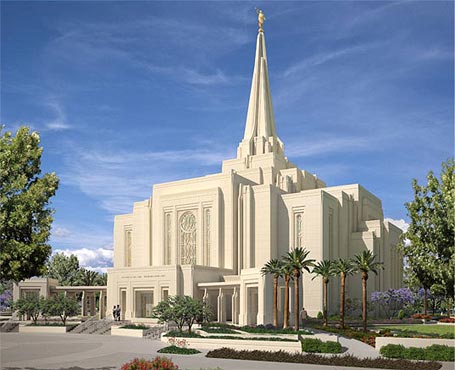
Gilbert Arizona LDS Temple

Gilbert Arizona LDS Temple

Every so often the public gets a chance to enter a Mormon Temple to get a peek at what goes on inside. These rare opportunities present themselves before the religious dedication of newly built buildings or on occasion renovations. In some ways these are equal parts public relations and celebrations. Local Arizona news for channel ABC 15 had a report that claims a look inside the pre-dedication constructed Gilbert Arizona Latter-day Saint Temple, although it is more a report about the background and people involved. Non-Mormons are not the only ones that have very little information about what takes place once declared a Holy Sanctuary.

The hesitancy to discuss the specific aspects of activities and rituals keeps the members of the LDS Church who haven’t gone from knowing what to expect. First time attendees often describe their initial experience as shocking or disorienting. This despite the fact that there really isn’t anything untoward that is said or happens. In fact, many who have repeatedly attended say it becomes rather boring. A few claim to have fallen asleep, with some evidence to back that up. The newness of it all strikes almost everyone as disjointed from typical chapel worship. Some don’t recover and never return.

Blame for this is often placed on a lack of preparation. There is some truth to this. Because of the sacred nature of the Temple activities, only vague references can be divulged. There is a certain feeling among Mormons that the whole topic is off limits. Such a position goes too far, considering how much information exists in a study of General Conference talks on the subject of the Temple. How much can those who would be going for the first time be prepared? That is not an easy question to answer. Continue reading

Non-Mormon Mormon Movie: ‘About Time’

If you get a chance, I highly recommend the British movie “About Time,” which is filled with so many Mormon themes you would swear the writers were LDS.

The movie is about a British family in which the men are time travelers. They can only travel back in time (not into the future). The awkward son in the family Tim Lake (Domhnall Gleeson) discovers this on his 21st birthday. Of course he is skeptical, but he is told to go to a dark closet, make fists to concentrate and imagine a time in his life that he would like to change, and –voila! — he is taken back in time. He says he will use his new power to find a girlfriend.

SPOILERS coming.

Here are some of the surprising Mormon themes:

–The time travelers appear completely uninterested in earning money with their powers. The very down-to-Earth father warns that pursuing money has made past family members very unhappy.
–They only use this power for small things involving their relationships with much-loved family members. (They show no interest in changing large, world-affecting events).
–The father played by the great Bill Nighy reveals that he primarily uses time travel to 1)spend time with his family 2)read good books 3)learn to appreciate life by reliving days twice, adopting a positive attitude the second time around. Tim does this, and we discover the age-old adage that it is not what happens to you, it is how you respond to what happens to you.
–Tim is very seriously involved with Mary (Rachel McAdams) but has a chance to hook up with a gorgeous past love (Charlotte, played by Margot Robbie). She invites him into her apartment, and Tim realizes he really is in love with Mary, and he literally runs away from Charlotte to avoid temptation. This scene would make a great young men’s lesson on chastity: infidelity is not worth it.
–Tim believes in marriage and in fidelity throughout his life. He is completely focused on Mary and has no interest in another woman. (Imagine how many Hollywood movies would show him fooling around with other women).
–Tim wants to have an unusually large (for modern Europe) number of children (three). He does this despite the fact that his friends and most people around him spend their time saying they are not interested in children.

The primary theme of the movie is completely aligned with David O. McKay’s statement that “no success can compensate for failure in the home.” Given all of the infidelity, violence and ugliness that is glorified in movies these days, “About Time” was a nice surprise.

A few warnings: unfortunately, this movie has a few unnecessary F-bombs and S-bombs. It is also worth pointing out that there are a few sexy scenes and that the main characters do hop into bed almost immediately, so this movie may not be appropriate for children and some younger teenagers. But overall, a very well-done movie.