
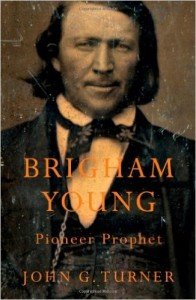
Bigger than Life Prophet: Review of John Turner’s B.Y. Biography

BYPPDuring his life, Brigham Young was among the most hated and feared men. Even some of those who supported him didn’t always get along with his irascible personality. National newspapers often portrayed him as a portly womanizer on the verge of destroying the progress of a modernizing civilization. International opinion agreed, although they saw him as the result of an upstart and untamed United States. The Mormons, along with Brigham Young, were seen as a force to be reckoned with or an unspecified moral doom would be the result. Many generations later he is still mocked and derided with the same images started in Eastern newspapers. Among current Mormons his image is rough, but strong as his statues in Utah. Both believers and detractors have made him into an legendary icon of opposing saint and sinner visions.

The biographer John G. Turner hoped with his book to slice through the competing images of a man who was either a hero who built half the Western U.S., or committed every crime imaginable. Like most things Mormon it wouldn’t be an easy task. Turner believed Stanley P. Hirshson’s The Lion of the Lord relied too heavily on Eastern newspaper accounts, and Leonard J. Arrington’s Brigham Young: American Moses slanted too positive as a loyal follower of the religion. He wanted to use more first hand accounts and reminiscences to build a better biography that accepted both the good and the bad about the man. With some reservations the book succeeded.

Stylistically it reads almost like a companion to Richard L. Bushman’s Joseph Smith: Rough Stone Rolling by giving the participants benefit of the doubt through their own words. Nothing seems to have been written to try and undermine or explain away spiritual experiences. There are some differences in subject treatment. Turner doesn’t focus as much on the theological developments and teachings, except where there is a direct connection to events. He uses theology to try and understand why Brigham Young or his followers behaved a certain way, while Bushman sometimes went off on a theological or philosophical tangent. In no way does this take away from the whole of the book, but sometimes it can feel like unexplored gaps remain. Considering that the biographer is a non-Mormon it probably is for the best. Even if he has a decent and mostly unobjectionable understanding of Mormon theology. Very few Mormon readers should be offended by doctrinal treatments, although certainly have a few disagreements with interpretations. Continue reading
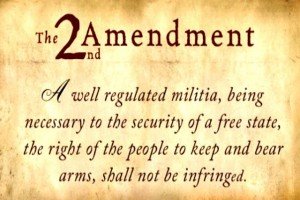
The Mormon Case Against Gun Control

2ndAmendmentAll over the Internet has been talk of gun control and the current President’s executive order to extend background checks for those selling firearms. He and his supporters believe that too many guns have created a deadly culture of violence. Counter arguments have sprung up that all the crimes used to back laws for more gun restrictions would not have been avoided. No lives would have been saved by free background checks because criminals don’t follow the laws anyway.
The other concern is that making it harder to obtain and carry guns puts handicaps self-defense and puts innocent lives at risk. Many believe the underlying problems of mental illness and unchecked illegal immigration are ignored or worse, in case you are conducting a hiring campaign, check this service allowing to search for someone by name online. Mormon scripture and history contains evidence that blocking people from having weapons is a death sentence when up against the hearts of murderers.

History has examples of government or hostile forces restricting or taking guns away from people and then attacking them. The Ottoman Empire in 1911 passed a law banning guns, and within a few years started what is known as the Armenian Holocaust with 1.2 million deaths. Armenian soldiers fighting for the same side as the Ottomans in WWI were disarmed and killed after placed in labor camps. Of course, Nazi Germany is the most famous example with a law in 1938 banning all guns for Jews while deregulating for almost everyone else. He also stated in 1942, “The most foolish mistake we could possibly make would be to allow the subject races to possess arms. History shows that all conquerors who have allowed their subject races to carry arms have prepared their own downfall by so doing. Indeed, I would go so far as to say that the supply of arms to the underdogs is a sine qua non for the overthrow of any sovereignty.” (Hitler’s Table-Talk at the Fuhrer’s Headquarters 1941-1942, Dr. Henry Picker, ed. Athenaum-Verlag, Bonn, 1951). In other words, he taught those with the guns controlled those who didn’t have them. The American frontier proved this many times with the U.S Government treatment of Indians. Most of the military raids were to disarm the Native Americans and drive them from their homelands or outright kill them. Custard’s last stand represents what happens when armed resistance is possible against a hostile force. In the end one battle didn’t matter against the tide of Western American history, but that day would have seen an Indian massacre instead.

As a matter of consideration, the true Gospel is one of peace and avoidance of violence. Jesus Christ who came to offer Salvation to humanity is known as “The Prince of Peace” (Isa. 9:6) preaching love. His greatest sermon proclaims, “Blessed are the peacemakers: for they shall be called the children of God” (Matt. 5:9). The faithful are required to “Love your enemies, bless them that curse you, do good to them that hate you, and pray for them which despitefully use you, and persecute you,” (Matt. 5:44) because its easy to love those who already show love. It is much harder to do the same for people that are seen as an opposition.One of the stated reasons for the Great Flood was the constant violence (Gen. 6:11) that filled the Earth. Continue reading

Disagreeing with LDS Prophets and Apostles vs Losing Confidence in Them

815px-041A.Moses_Breaks_the_Tables_of_the_Law

[Cross-Posted from Sixteen Small Stones: Disagreeing with LDS Prophets and Apostles vs Losing Confidence in Them]

Among some members of the Church of Jesus Christ of Latter-day Saints, it has become increasingly common to openly and publicly criticize teachings, directions, decisions, and policies of the prophets and apostles of the church.

I recognize that this trend is at least partially the consequence of a more general societal shift in attitudes and perceptions of privacy; a shift that is influenced by blurring lines between the public and the private driven by information technology and the Internet.

As long-time readers of my blog know, I am very troubled by this trend. I am troubled by the nonchalance with which members of the church confidently declare that they know that the prophets and apostles are wrong about this-or-that.

While I have have written extensively about this and related topics, I recognize that my posts are long, disconnected, and probably not very accessible to casual readers. When you are discussing the issue in the comments of social media, pointing to pages and pages of blog posts written over the course of several years just doesn’t work well.

So here is my attempt to distill my reasoning into a single, more succinct and consumable post: Continue reading

Two Forms of Revelatory Policy Changes

I am currently in Israel visiting family, and decided this morning to go on a walking tour of Jaffa. On the tour, the tour guide spoke of the events that led Cornelius the centurion to Peter and culminated in the opening of the Gospel to the gentiles.

In light of the debate over whether current policy changes are inspired and truly the will of the Lord, I reflected on this most monumental shift in policy ever occurred in the history of the Church. Before Peter’s vision, only those who were Jewish by descent or laborious conversion could be baptized into the nascent Christian Church. After his vision, the scope and power of the Church of Christ dramatically changed as the message spread to all mankind.

There were two key revelations regarding the Church’s policy towards the gentiles, and I believed that looking at these two different policies helps to reveal how God guides his Church today.

The First revelation came to Peter in the vision regarding eating unclean animals. After this vision, Peter knew God’s will decisively and he knew that the Gospel could go to the gentiles. This was a direct revelation of a very specific nature , and Peter immediately shared this vision with the whole Church so that it would know that the instruction came from God.

But after this vision, there still remained the difficult work of figuring out how to implement the newly revealed policy of preaching to the gentiles. In Act 15, we read about the great counsel where the Apostles and Elders came together under the direction of the First Presidency to consider what limitations should be placed on newly converted Gentiles. Peter and James lead this meeting and seek the guidance of the Lord. And from this meeting comes a divinely inspired policy that “seemed good to the Holy Ghost.” This policy revelation involved no clear “thus saith the Lord” moment. Peter didn’t receive a vision, James didn’t speak in the name of the Lord. Yet, there is no question that Peter and James received binding revelation which was accepted by the whole Church as inspired policy.

These  two models of revelation still exist in the present Church. Sometimes, policy is revealed through a dramatic vision or through “thus saith the lord” revelation. Other times, it is instead revealed through inspired and prayerful contemplation and under the guidance of the First Presidency. Both are inspired and both are revelatory. If we demand the former type and reject anything revealed through the latter model as uninspired, we will be doing a grave disservice and sowing the seeds of doubt and dissension.

Elder Nelson makes clear the LDS policy on same-sex attraction is the ‘will of the Lord’

The Salt Lake Tribune has a story on Elder Nelson’s talk to young adults Sunday night in which the senior apostle makes it as clear as can be that the Church’s policies are the will of the Lord.

The Mormon Newsroom has not reported on the talk yet, so my post will have to rely on the report from the Tribune, but here are some key paragraphs:

After same-sex marriage became legal in several countries, including the United States, the LDS Church’s top 15 leaders wrestled with what to do, weighed all the ramifications, fasted, prayed, met in the temple and sought God’s guidance on the issue.

Balancing their understanding of Mormon doctrine about the “plan of salvation,” which is built on male-female marriage, with compassion for children of same-sex couples, Russell M. Nelson, head of the Quorum of the Twelve Apostles, said Sunday night, “we considered countless permutations and combinations of possible scenarios that could arise.”

Then President Thomas S. Monson, considered a “prophet, seer and revelator” in the 15 million-member Church of Jesus Christ of Latter-day Saints, declared “the mind of the Lord and the will of the Lord.”

That led to the Utah-based faith’s new policy regarding same-sex Mormon couples — that they would be labeled “apostates” and that their children would not be allowed baptism and other LDS religious rites until they turn 18.

“Each of us during that sacred moment felt a spiritual confirmation,” Nelson, next in line for the Mormon presidency, told the faith’s young adults in the first official explanation of the hotly debated policy’s origins. “It was our privilege as apostles to sustain what had been revealed to President Monson.”

Nelson explained that revelation from the Lord to his servants is a sacred process.

“The [three-member] First Presidency and Quorum of the Twelve Apostles counsel together and share all the Lord has directed us to understand and to feel, individually and collectively,” he said. “And then, we watch the Lord move upon the president of the church to proclaim the Lord’s will.”

Elder Nelson also said that this is a time for choosing:

Continue reading