
Finding Relatives

RelativeFinder.org is an amazing website for determining relationships between people. With the updated interface, you can use it to determine relationships between any two people who have records in FamilySearch.org.

Hey, Cousin!

It has been amazing to me to see how I’m related to people I would never think had any kinship to me at all. For example, the current mission president in my area comes from a Jewish family. Yet he’s my 10th cousin. His wife is also a 10th cousin, though along a different line.

One of the fun things Relative Finder does is tell you if/how you are related to various famous people. Want to know if you have actors or athletes or scientists in the family tree? Relative Finder can do that for you.

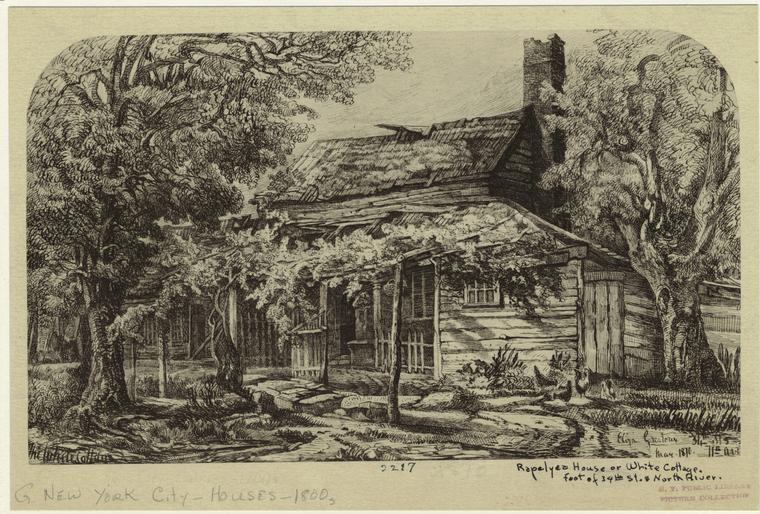
The image above is from the Rapelje home circa 1800. Joris Rapelje (19) and his bride, Catalynje Trico (18) were amongst the first settlers of New Amsterdam (now New York City). Catalynje is my 11th Great Grandmother. Her daughter (also my direct-line ancestor) was the first European child born in New Amsterdam (a settlement on the southern tip of Manhatten).

Curious whether two people you are researching might be related? Just grab the Person ID (PID) number (XXXX-XXX format) for the two folks in Family Search and go to “Connect: Connect two deceased people” or use “Relatives: Masquerade” to search out famous relatives of a deceased person.

Turns out Emma Hale [Smith] is my 4th cousin (a few times removed). Her Relief Society officers are also cousins or direct ancestors (for example, Eliza Snow is a 6th cousin).

Not everyone who has fascinated me is a cousin.

I adore Catherine Laur [Fuller Warren], but she is not my cousin. Her husband, who died at Haun’s Mill, is a cousin, however. For a moment, I thought maybe I could reserve ordinance work for her children, one of whom (John Fuller) I entered into Family Search after finding his records in 2016. Alas, someone else enjoyed the privilege of performing his proxy ordinances, less than two weeks after I added him to Family Search.

Another person I adore is Marie Boulen [du Four], an early Walloon protestant who died around 1650. I tumbled across Marie when a daughter was doing proxy baptisms a few years ago. Marie’s husband and son emigrated to New Amsterdam with the new Mme du Four after Marie’s death. Even though the island of Manhatten used to be a tiny place, which Marie’s son shared with my Walloon ancestors, I do not appear to be related to Marie Boulen.

No More Strangers

Though we might not all be traceable cousins, our congregations are filled with people who are in turn kin to much of the world. The ancestors and cousins of your friends undoubtedly include individuals from every political stripe and nation in the world. The other night I learned that a friend’s grandfather was a key adviser to General Franco of Spain.

I myself am grand-daughter of a former General who served Chiang Kai-shek. Through that lineage, I am undoubtedly related to millions of Chinese in Fujian province and Taiwan.

Our family is currently reading the portion of Alma that talks of the missionary labors of Ammon and Aaron. They chose to minister to a nation with whom their ancestors had been at war for centuries, even though lore told them the two nations arose from a common parentage. This willingness to sacrifice on behalf of former enemies is a tale we don’t see in the Bible, other than in the sacrifice of Christ himself. And Christ himself never directly ministered to those outside the family of Israel. The closest the Bible comes to the inclusive love of Ammon and Aaron is the story of how Jonah, under duress, was eventually willing to preach to the people of Nineveh.

The entire Book of Mormon is a love letter from a doomed people to us, people to whom they were not known kin. Throughout the Book of Mormon, we learn of God’s desire to unite us all with our best hope of heaven, God’s commitment to the covenant He made with us from before the foundation of the world.

I encourage you to reach out to learn more about your relatives, the struggles they endured, the cultures they embraced, and the good they did. In today’s polarized world, we can find unity and perspective through understanding our relatives in the complex human past. We can push past labels and xenophobia to find commonality and shared history.


Of Salome and Snow White

Salome with the Head of John the Baptist by Jan Adam Kruseman (1804-1862)

The death of John the Baptist is rather distinct. In the gospel according to Mark, John’s preaching angered the wife of Herod Antipas, who had John beheaded.[ref]Mark 6:17-28[/ref] Mark says Herod’s wife schemed to achieve this death by using her daughter, who Josephus identifies as Salome.

Because this tale is so unique, I was struck by the similarity between the Salome narrative and the tale in Ether 8 & 9 in the Book of Mormon. Ether 8 tells us of King Omer and his traitorous son, Jared. When Omer is able to regain the kingdom from Jared, the daughter of Jared schemes, telling her father to:

… send for Akish, the son of Kimnor; and behold, I am fair, and I will dance before him, and I will please him, that he will desire me to wife; wherefore if he shall desire of thee that ye shall give unto him me to wife, then shall ye say: I will give her if ye will bring unto me the head of my father, the king.

Ether 8:10

The dancing and the desire of a young woman to be gifted the head of a parent’s rival seemed a bit too similar to the account of the death of John the Baptist. And this gnawed at me for a while. Then I reasoned it out a bit more.

Most of us are familiar with the tale of Snow White, whose jealous step-mother plots to murder the beautiful girl. The Queen orders the huntsman to take Snow White into the woods and kill the child, bringing the child’s organs (variously lungs, liver, or heart) back in a box as proof.

Upon mature reflection, however, the Wicked Queen’s plan is stupid. Hearts (and other organs) are fungible. In other words, there is nothing that identifies one heart as belonging to a hated foe and another heart as belonging to a wild boar. The Brothers Grimm wrote the Queen engaging in stupidity because it allowed their young heroine to escape.

A Wicked Queen that wasn’t so stupid would have demanded that the huntsman return with some uniquely identifiable piece of the hated child, a portable piece which ensured the hated child was no longer alive. Like a severed head.

Throughout history the heads of foes have been used to prove that a victor has succeeded. But relatively few of these heads are documented as having been demanded by a dancing maiden.

The similarity of the stories of Herod’s step-daughter and Jared’s daughter irritated me for a bit. But upon reflection and study, I found that the stories of Salome and the daughter of Jared are not actually unusually similar. Ultimately the dancing treachery of Jared’s daughter ends up costing Jared his head, and the man who married Jared’s daughter kills their son out of fear. Eventually all those with whom the daughter conspired destroy one another, and an ancient Omer returns to rule over the land Jared had usurped.

Another factor is that women tend to be under-documented. We see this with Salome, who is not mentioned by name in the Bible. The Luke account does not mention the daughter’s dancing in the series of events leading to John’s death. Scholars consider the Mark account as source material for the Matthew account, so it is not clear if Matthew is a corroboration or merely a restatement of the Mark account.

Why do I tell you this tale of my passing discontent? Perhaps it is because when one has worn patterns of inquiry and cynicism into one’s soul over a period of time (as I did in my younger years), there are moments when even a repentant and staunch believer might trip on an unexpected mole hill.

When this happens, the believer will right themselves, examine the mole hill, and figure out how to avoid allowing this mole hill to have crippling power. A believer will certainly avoid building the mole hill into a mountain. A believer will also avoid intentionally tripping on other mole hills.

Along the lines of moles and inquiry, I highly recommend you watch the comments Elder and Sister Renlund gave at BYU Hawaii this past Sunday (available at lds.org).

P.S. – There’s a new interface for authoring posts on M*. I haven’t mastered it yet, so I apologize up front if there are elements of this post that seem irritatingly different.

Music Monday: If Ye Love Me Keep My Commandments

This year’s theme scripture for the Young Men and Women is John 14: 15, “If ye love me keep my commandments.” Last week in our ward’s mutual opening exercises, we all stood and repeated this scripture together. It was very powerful for me sitting on the back row, with my two year old daughter on my lap. I was so glad she was able to hear these young women and men say this short, but powerful declaration. The Spirit was there as these words were said, and these teenagers believed what they were saying. It was powerful.

In this arrangement The Swingles (nee The Swingle Singers), are singing this scripture set to music by the 16th Century composer Thomas Tallis, which has been arranged for double choir by Kevin Fox. The parts loop over and over each other, which creates a beautiful choral round.

The text also continues with verses 16-17. The whole passage reads:

1 If ye love me,keep my commandments.

16 And I will pray the Father, and he shall give you another Comforter, that he may abide with you for ever;

17 Even the Spirit of truth;