
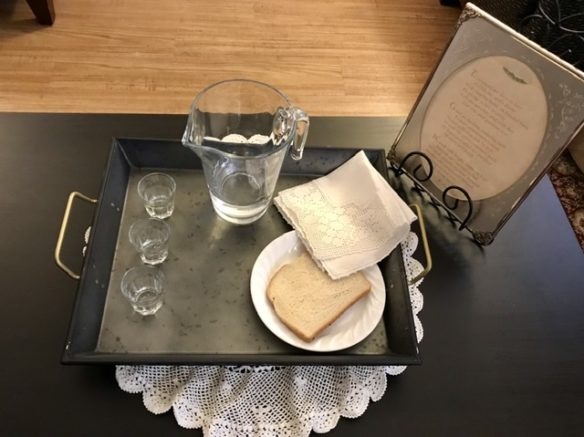
Virtual Worship Tips

We all know that some ordinances must be administered in person, such as marriages, baptisms, blessings, and partaking of the sacrament. However it is possible to continue many aspects of community worship using other methods. For those who haven’t yet been invited to share in virtual congregational meetings, I wanted to share how this can be done.

Live Gatherings

My local Relief Society used Zoom for a gathering to discuss gardening and how to make bread. While there are several other platforms for communicating, Zoom offers several benefits:

  • Participants can use either a computer or their phone or can even join using a land line. There is no need to have a specific type of computer or to be a member of a particular social media platform.
  • Zoom offers unlimited time for any conference between just two participants.
  • Zoom offers free 40 minute sessions for more than two participants (up to 1000 participants, I believe)
  • Zoom allows you to record the video and audio content, including separate audio for each participant, allowing savvy folks to edit together a polished product after the fact.
  • “Zoom” is easier to say than anything that has more syllables (e.g., FreeConferenceCall.com)

My local Relief Society will begin gathering virtually on alternating Sundays at a set time on Sunday afternoons.

Our congregation has had an “empty nesters” group for Family Home Evening for many years. With the advent of the stay at home orders and cancellation of live Church meetings, this has also migrated to Zoom. Useful tips for live meetings:

  • Set the meeting so everyone is muted by default when they join.
  • Designate a moderator for the meeting – preferably rotating this opportunity. This doesn’t need to be the meeting host. The moderator can help make sure everyone gets a chance to participate.
  • Conduct a wee bit of training so people know how to use the “raise hand” feature. Those old Primary habits can help ensure a conversation that comes closer to order than the chaotic default.

Pre-recorded Devotionals

Folks in my local congregation have mad media skills. Since March 29 leadership has been assembling devotionals to support our Sabbaths. Talk about home-centered, Church-supported worship! The Easter devotional is inserted above.

The format of these devotionals has typically been:

  • Opening remarks
  • Opening Song
  • Opening Prayer
  • Church video (Easter was about the Holy Week, last week was President Nelson’s reading of the Restoration Proclamation)
  • Talks and music provided by members of the congregation
  • Sacramental Song
  • Closing Prayer for the devotional and invitation for households to administer the sacrament in their homes if there is someone available who is authorized to administer the sacrament.

I’m not part of the team that puts together our Annandale Devotionals, and I don’t know how they managed some of the magic that resulted in this devotional. For example, the performance of Beautiful Savior involved a singer in Annandale and a pianist in Utah. But as a moderately-informed person, here are suggestions on how such devotionals can be created:

Continue reading

Book Review: 2nd Nephi – a brief theological introduction, by Terryl Givens

Book Review: 2nd Nephi – a brief theological introduction, by Terryl Givens

“A little learning is a dangerous thing.
Drink deep, or taste not the Pierian Spring;
There shallow draughts intoxicate the brain,
and drinking largely sobers us again.” Alexander Pope

2nd Nephi, by Terryl Givens, is the second book in a series by the Maxwell Institute on theology in the Book of Mormon (see 1st Nephi by Joseph Spencer, here).

Theology is the study of God. While other religions have a theological base that determines and establishes their doctrines and beliefs, Latter-day Saints have only begun to study or “do” theology in the last few decades. Yes, we are very good at history, “likening” the scriptures to our day, apologetics (defending the gospel), and finding archaeological  discoveries that support the Book of Mormon, but we have not spent the time to intensely study the text of the Book of Mormon. As noted in the book series, C.S. Lewis remarked that in studying the gospel, we tend to be “hurried tourists” who only spend a few moments in the entry way. This series is a beginning for the average reader of the Book of Mormon to begin to sober up by drinking deeply.

In its short 93 pages, Givens gives a refreshing and stimulating look at what he sees as the key points taught by Nephi, Lehi and Jacob in 2nd Nephi. The book is divided into four chapters or sections:

1. The New (and Very Old) Covenant
2. They are not Cast Off
3. To the Convincing of Jew and Gentile that Jesus is the Christ
4. More Plain and Precious Things

There are many amazing insights in the book, and I’ll share a couple, knowing I cannot do the book justice.

Givens explains why Nephi divided his works into two books, and why he separated them where he did.  In 1st Nephi, Lehi tells us that Jerusalem is going to be destroyed. There is doubt among some of his followers. Laman and Lemuel attempt several times to return to Jerusalem, even though their father has made such an incredible claim. 2nd Nephi begins with Lehi telling his family that he saw Jerusalem destroyed in a vision. Just think of the shock this would be to the whole family!

Palestine had been the Promised Land since the days of Abraham. The Abrahamic Covenant and the land were inseparable. Moses brought the children of Israel out of Egypt and returned them to the land of promise. Under King David, Jerusalem became the capitol of the Promised Land. Solomon built the temple. It was the place with the ark of the covenant, the Presence of God.

Imagine being an astronaut, suggests Givens in a thought experiment, headed to a new colony on Mars. Your history is earth. It is the place of your birth and the place of your ancestors. It is where your loved ones are, whom you communicate with over the expanses of space. After living on Mars for a time, you suddenly get notice that earth is destroyed. There is no return trip, no communication with loved ones. “Planet earth, their home, with teeming cities and myriad peoples, with its cultural monuments and holy places, with its childhood haunts and familiar vistas–is no more.”

Suddenly, we find ourselves in the realm of Laman and Lemuel, knowing the city and life they loved, was no longer there. All of their beliefs and hopes lay in ruins, as the promised land was destroyed. In this scenario, Lehi and Nephi can describe a new Land of Promise, with Lehi’s family as the seven Tribes of Israel. Nephi’s newly constructed temple replaces the once majestic temple of Solomon, which now was rubble. The ancient covenant continued with Lehi’s family.

Givens discusses how the “new and everlasting covenant” is one that has been around not just since Adam, but since the premortal existence. While the rest of the Christian world condemns Adam and Eve for our sinful nature, the Book of Mormon celebrates their choices, which was part of the eternal plan. He explains several traditional Christian doctrines, such as original sin and predestination, which the Book of Mormon proclaims as wrong. It also explains why they are wrong, and why at birth we are closer to a “blank sheet” of paper with agency to choose, rather than depraved and evil with no redeeming qualities nor any ability to choose good for ourselves.

2nd Nephi discusses two of the key concepts that Moroni placed on the Title Page of the Book of Mormon: that the Jews/Israel are not cast off, and that Jesus is the Christ. Givens shares important insights into both of these key issues. In speaking of the atonement and resurrection of Jesus, Givens notes that since “those earliest heavenly councils, the everlasting covenant depended upon and centered around the grace-drenched offer of Jesus Christ to be the Atoning One, our healer and guarantor of life eternal.”

While the Bible discusses the life and mission of Jesus, it does not do so to the level and depth that the Book of Mormon does. As Catholic scholar Stephen Webb* once noted, the Book of Mormon emotes high-Christology throughout the volume. Givens gives several examples in 2nd Nephi regarding the importance Jesus Christ, the atonement and resurrection, really are to Nephi and his contemporaries.

There are so many more gems to be found in this small book. In reading Givens’ 2nd Nephi, I know that the next time I read the Book of Mormon, I will study it with new eyes, a new heart, and a better understanding and appreciation for what Lehi’s family was experiencing, and how the everlasting covenant, through Jesus Christ, is more than just a piece of land in Palestine. With this book and series, we no longer need to sip from the Pierian Spring, dizzy from an occasional spiritual moment. Givens’ 2nd Nephi will help us drink deeply and experience the true spiritual power of the Book of Mormon.

Available at Amazon.com


* My live blog post on a Fireside with Alonzo Gaskill and Stephen Webb

Good, Fast Friday

Today we are fasting on behalf of those suffering because of the Coronavirus pandemic, that health workers will be protected, that the economy may recover quickly, that suffering may be alleviated throughout the world.

This is also Good Friday, the commemoration of the crucifixion of Jesus Christ, the tragic death that preceded Christ’s resurrection from the dead. In many Christian faiths, Good Friday is a time of fasting, signaling the final stages of Lent, forty days of sacrifice in honor of Christ’s forty day fast at the beginning of his ministry.

For some moderns, this tradition of sacrifice may seem meaningless. But this skepticism ignores the fact that the effect of our thoughts and concerns can be felt far beyond the limits of physical communication.

I myself don’t have too many stories of miracles specifically related to fasting, other than the fact that every time I have taken a personal concern to the Lord during a fast, I could no longer remember why it had been such a concern by the end of my fast.

However I was raised by a mother around whom miracles manifested on a regular basis. We regularly prayed before going on car trips, specifically so the car would run. On one particular cross-country trip the lights didn’t seem to work, and mother prayed as she drove throughout the night for the lights, anxious that we arrive at home in time for us kids to be able to attend the first day of school. Well after midnight Mom began to feel foolish – surely her prayers couldn’t actually be making a difference. As she stopped her prayers, the lights dimmed to darkness. She resumed praying. The lights brightened.

Continue reading

The Hosanna Shout

What is the Hosanna Shout? | LDS Daily

Greetings friends! General Conference is off to a spiritual and exciting start. If you did not have a chance to listen to the Saturday morning session, please go back and listen to Pres. Nelson’s opening remarks. They are important! He let it be known that the Sunday Morning session of Conference will be a Solemn Assembly and that we will have the great opportunity to participate in the Hosanna Shout.

Here are some links to refresh your mind on what these are:

What is the Hosanna Shout?

Viewpoint: Why We Shout “Hosanna” for Holy Temples

From the Deseret News: What a solemn assembly is and why President Nelson said the church will hold a Hosanna Shout on Sunday

This link gives some history on why we do the Hosanna Shout and when it has been done in times past, Temple Dedications and Dedicatory Prayers.

What is a Solemn Assembly?

Some historical context and history about Solemn Assemblies.

A video of the most recent Solemn Assembly which was in 2018, when Pres. Nelson was sustained as the prophet.

It should also be noted that tomorrow is Palm Sunday — the day of Christ’s Triumphal Entry into Jerusalem for the last week of his mortal life — the start of Holy Week. When He entered the people shouted:

“And the multitudes that went before, and that followed, cried, saying, ​​​Hosanna​ to the Son of David: ​​​Blessed​ ​is​ he that cometh in the name of the Lord; Hosanna in the highest” (Matthew 21: 9).

Traditionally for the Hosanna Shout you wave a white handkerchief, but if you don’t have one you can wave your hand instead. I’m scouring the drawers this afternoon. I know we have a stash of Grandpa’s handkerchiefs somewhere.

I hope you and your family enjoy Conference and that you will leave your thoughts with us here.