
When the Temple Helps: Bound by Family Ties

ancestral-treeGoing to the temple is about more than the ritual and theological discourse. They are of course essential, because without them there would be no temple experience. Yet, the only reason a believer can return is out of obligation to people who have died. That means researching genealogy. Preferably the LDS Church leadership wants us to locate our own ancestors. Spiritual and temporal blessings can accompany the process of searching, locating, indexing, and doing the temple work for deceased individuals. The more involved at the start, the greater the satisfaction. For some it gives the same feeling as helping a living person become converted to the gospel.

Nothing has ever been easy about the work. When Joseph Smith first taught the gospel doctrine of baptism for the dead, members rushed to the banks of the Mississippi River and immersed themselves in behalf of any deceased relative that came to mind. They didn’t even consider if doing so for the opposite gender was appropriate. All they knew was a great mission of salvation had opened up and they were excited to participate. Joseph Smith had to pull them back and explain (Doctrine and Covenants 127:5-8) that it had to be done in an orderly fashion accompanied by written records:

5 And again, I give unto you a word in relation to the baptism for your dead.

6 Verily, thus saith the Lord unto you concerning your dead: When any of you are baptized for your dead, let there be a recorder, and let him be eye-witness of your baptisms; let him hear with his ears, that he may testify of a truth, saith the Lord;

7 That in all your recordings it may be arecorded in heaven; whatsoever you bbind on earth, may be bound in heaven; whatsoever you loose on earth, may be loosed in heaven;

8 For I am about to restore many things to the earth, pertaining to the priesthood, saith the Lord of Hosts.

He also explained in revelation that a Temple had to be built for the baptisms, and other works of salvation, to continue. Because there was not yet one on the earth, they would be accepted without for a short time.

Work in behalf of the dead is so important that the first message of the gospel by the Angel Moroni to Joseph Smith contained a repeated quote on the subject. As reported by Joseph Smith, “And again, he quoted the fifth verse thus: Behold, I will reveal unto you the Priesthood, by the hand of Elijah the prophet, before the coming of the great and dreadful day of the Lord. He also quoted the next verse differently: And he shall plant in the hearts of the children the promises made to the fathers, and the hearts of the children shall turn to their fathers. If it were not so, the whole earth would be utterly wasted at his coming” (Joseph Smith—History 1:38–39). Once the doctrine of temple work was revealed and the keys delivered by Elijah, the quotes were explained more in-depth (Doctrine and Covenants 128:15,18):

15 And now, my dearly beloved brethren and sisters, let me assure you that these are principles in relation to the dead and the living that cannot be lightly passed over, as pertaining to our salvation. For their salvation is necessary and essential to our salvation, as Paul says concerning the fathers—that they without us cannot be made perfect—neither can we without our dead be made perfect . . .

18 I might have rendered a plainer translation to this, but it is sufficiently plain to suit my purpose as it stands. It is sufficient to know, in this case, that the earth will be smitten with a curse unless there is a welding link of some kind or other between the fathers and the children, upon some subject or other—and behold what is that subject? It is the baptism for the dead. For we without them cannot be made perfect; neither can they without us be made perfect. Neither can they nor we be made perfect without those who have died in the gospel also; for it is necessary in the ushering in of the dispensation of the fulness of times, which dispensation is now beginning to usher in, that a whole and complete and perfect union, and welding together of dispensations, and keys, and powers, and glories should take place, and be revealed from the days of Adam even to the present time. And not only this, but those things which never have been revealed from the foundation of the world, but have been kept hid from the wise and prudent, shall be revealed unto babes and sucklings in this, the dispensation of the fulness of times.

Many today continue to gain comfort from knowing those who pass from this life can still receive the ordinances of the gospel. A member of the LDS Church who participates in genealogical work can have greater appreciation for the temple. They will learn more about their families and feel better about themselves. The spirit of Elijah will become real for them as they search out and do temple work for their ancestors. Continue reading
Scapegoats in the Book of Mormon

Recently, scholar Andrei Orlov* uploaded a paper to Academia.edu, entitled “The Curses of Azazel”.  In this paper, Orlov uses the ancient document, Apocalypse of Abraham, to discuss the scapegoat of Yom Kippur, the Festival of Atonement.  His excellent article made me think of how such issues may also be found in the Book of Mormon. I will discuss it momentarily, after a brief introduction to the Festival of Yom Kippur and some other important issues to consider.

Yom Kippur

During Yom Kippur, the high priest performs very important functions. Among these ordinances, is entrance into the Holy of Holies (the only time during the year it is entered), sanctifies the instruments and Mercy Seat, and utters the sacred and ineffable name of God, “YHWH”. As he enters the Holy of Holies, he wears a special priest garb, which includes a turban/mitre, a sash, and the robes.  On his robes are bells, which tinkle as he moves, so those waiting outside for him can listen in and ensure he is still alive. If the high priest enters unworthily, God would strike him dead, and the silence of the bells would tip off his assistants to pull his body out by the rope attached to him for such an event. On the turban, one finds the name of “YHWH”. It is the unspeakable, ineffable name. Only the high priest knew the correct pronunciation. Some of his assistants would know portions of the pronunciation, but not all, so that at the death of the high priest, the assistants could each whisper their portion of the Name into the ear of the newly chosen high priest, allowing him alone to then know the full pronunciation.  The Name, as Orlov notes in his article, is extremely important. To have God’s name was to have his power to create, destroy, or perform miracles. Orlov notes from several ancient texts of fallen angels, or Watchers, who found out the Name and misused its power on the earth, causing them to be rejected by God.

One of the other major events in Yom Kippur, is that of the two goats. Two goats are chosen and brought before the high priest. One will be the sacred sacrifice, given to God. For Christians, this represents the sacrifice of Jesus by his Father.  The other goat, known as the scapegoat, also has an important role to play.  The high priest, prior to dressing in his temple robes, pronounces the sins of the people. Laying both hands on the head of the goat, he transfers those sins from Israel to the goat. A crimson wool thread is placed on the head of the goat. The goat is then sent into the wilderness, although some ancient texts show that it is pushed off a cliff, where it dies in a wilderness area. Those who lead the goat to the wilderness/death, then are to wash their clothes and become clean again from touching that which is unclean. Tradition has it that the scarlet thread became white, once the scapegoat was dead.  Orlov suggests that this directly ties in with Isaiah’s initial plea to Israel:

Wash you, make you clean; put away the evil of your doings from before mine eyes; cease to do evil;  Learn to do well; seek judgment, relieve the oppressed, judge the fatherless, plead for the widow. Come now, and let us reason together, saith the Lord: though your sins be as scarlet, they shall be as white as snow; though they be red like crimson, they shall be as wool. (Isa 1:16-18)

With this ordinance, the nation of Israel is absolved of its sins once a year.  For early Christians, both goats represented different aspects of Christ’s life: the sacrificial goat and the one who takes upon himself all the sins of the people.
Continue reading

Give Mormon apologists a break

Spending any time at all on social media can rapidly distort your sense of reality when it comes to what most Mormons believe. We often forget that more than half of Mormons live outside of the United States and that almost none of these people care about the petty concerns of the various factions out there. In my relatively conservative ward in rural northern Colorado, most people don’t follow any of the blog-based battles. Most people are simply too busy getting kids to and from school and various events, as well as doing their callings and trying to find time to go to the temple, to worry about the latest outrage fest.

But every once in a while I follow some on-line conversation down the rabbit hole and end up shaking my head at the angst among various factions. And apparently — unbeknownst to me — there are a LOT of liberal Mormons who hate Mormon apologists. And I am not talking about slight disagreements — I am talking about real hatred (at least in their on-line expressions).

I am not going to defend everything ever Mormon has ever done in the apologetics world. I am sure there are mistakes and exaggerations out there.

But I will defend my vision of the importance of apologetics, and it is really quite simple: Satan is happy to use deception to convince people not to be religious and not to believe in the Church. Good apologists simply point out the deception and provide another way of looking at things that supports a faithful point of view.

So imagine you were on the Sanhedrin when Christ was brought up for trial (see Matthew 26:57-67). The accusers were looking for false witnesses. I see apologists as the people willing to stand up and point out the deceptions going on. I see the apologists as those willing to point out all of the good things Jesus did. I see the apologists as those willing to protest a nighttime, unjust trial. I see the apologists adding their testimonies that Jesus is the Christ. What could possibly be wrong with opposing injustice, false reports and outright lies?

Continue reading

The Widow’s Testimony: Catherine Laur Fuller Warren

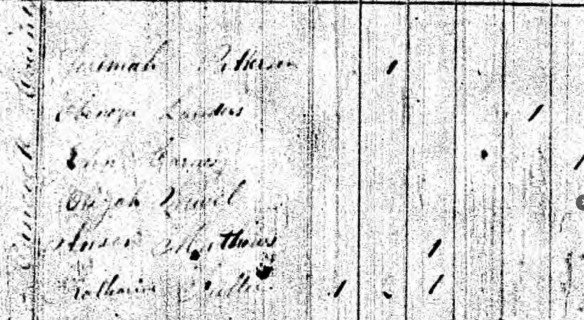
Fuller

This past weekend I was at Nauvoo for the Untold Stories Symposium. My topic was Catherine Laur Fuller Warren and her testimony against Dr. John C. Bennett. The audio below was recorded live, with minor edits to make it shorter (30 minutes vs. longer) and less blooper-filled. The powerpoint file for the presentation is also attached.

The Widow’s Testimony – powerpoint file

This, I felt, was the core of the new paradigm I have explored in my Faithful Joseph series. This is the previously untold history that is key to understanding everything else that happened in Nauvoo.

The trip to Nauvoo provided some interesting insights: Continue reading

The Smoke of the Fire

Elder David A. Bednar in the LDS Face2Face event for youth was asked a question by an eighth grader named David regarding how to stay strong in the face of constant opposition and skepticism from his peers at school. In response, Elder Bednar turned to the scriptures and pointed David to the story of Sadrach, Meshach, and Abed-nego. He promised that as David (and we) study this story, we would learn how to overcome opposition and stay unspotted from the world.

In particular, Elder Bednar pointed out one detail of the story that he thought was highly significant. When these brave young men emerged from the furnace, not was “an hair of their head” not “singed” but significantly “the smell of fire had” not “passed on them.” Elder Bednar noted that anyone who had ever been at a campfire would know that it was exceedingly difficult to keep the smell of fire off of us. And yet, these young men had been thrown into the midst of an exceedingly strong fire and yet emerged unscathed.

Elder Bednar suggested that we should ask ourselves how they were able to emerge from the midst of the fire without the smell of the smoke. I don’t know that I have a definitive answer to that question, but I did have a couple of thoughts.

First, the three were among those who consecrated themselves by avoiding the meat and wine of the king. Thus, they had kept the commandments of God and kept themselves pure from taint. Second, they were therefore given great spiritual knowledge, skill, and wisdom by God (Daniel 1: 17). Third, the three were unapologetic when asked by Nebuchadnezzar whether it was true that they refused to bow down to him. Fourth, they had sufficient faith both to be rescued and not to be rescued (“but if not”). It is significant to me that they did not demand rescue from God, but were willing to accept whatever he had in store. They placed their will in line with his. In Nebuchadnezzar’s words, they “yielded their bodies” in the service of God.
Continue reading