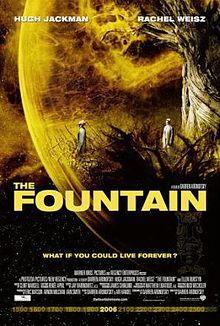
“The Fountain,” made in 2006, is a movie with Hugh Jackman and Rachel Weicz. It is a very artsy, controversial movie that shuttles between three different time periods over 1000 years. My wife didn’t like it but I really enjoyed it, and it has some very interesting religious themes having to do with eternal life and the nature of death.
It will be impossible to describe this movie without some SPOILERS, so for readers who are bothered by this read no further.
I cannot describe the movie better than the Wikipedia description, so let me go straight to that.
At its core, The Fountain is the story of a 21st century doctor, Tommy Creo (Hugh Jackman), losing his wife Izzi (Rachel Weisz) to cancer in 2005. As she is dying, Izzi begs Tommy to share what time they have left together, but he is focused on his quest to find a cure for her.
While he’s working in the lab, she writes a story about 16th century Queen Isabella losing her territory to the Inquisition while her betrothed, conquistador Tomás Verde plunges through the Central America forest in Mayan territory, searching for the Tree of Life for his Queen.
Since she does not have time herself, Izzi asks Tommy to finish the story for her. As they look out to the stars, she imagines that their souls will meet there when the star dies. And we see astronaut Tom, in 2500, travelling there for the event, in a spaceship made of an enclosed biosphere containing the Tree of Life.
The three story lines are told nonlinearly, each separated by five centuries. The three periods are interwoven with match cuts and recurring visual motifs; Hugh Jackman and Rachel Weisz play the main characters for all three narratives.[1] Even within a given narrative, the elements of that particular story are not told in chronological order.
Whether these stories are actual events, or symbolic, is not clarified; and, Director Darren Aronofsky emphasized that the storylines in their time periods and their respective convergences were open to interpretation.[2]
The director has said of The Fountain’s intricacy and underlying message, “[The film is] very much like a Rubik’s Cube, where you can solve it in several different ways, but ultimately there’s only one solution at the end.”[2]
In a 2012 interview, Aronofsky stated that “ultimately the film is about coming to terms with your own death”.[3]