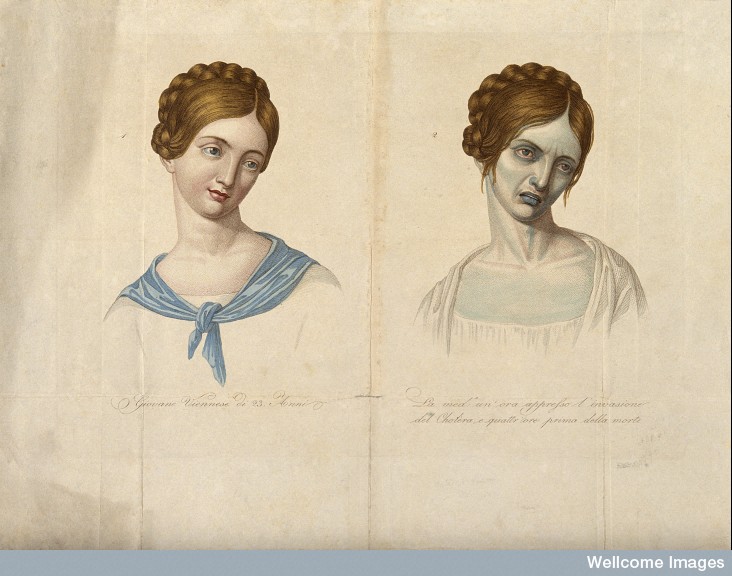
A young Venetian woman, aged 23, depicted circa 1831 before contracting cholera and a quarter hour before her death. Coloured stipple engraving. Courtesy of Wellcome Library
In the early 1800s a new and terrifying ailment swept through large cities. It was first identified in India (1817), afflicted St. Petersburg in Russia (1828), then hit London and New York (1832).
For decades most people were satisfied with their certainty that this ailment was caused by sin. If you were sick, it was your fault.[ref]Harning, Lisa N., Comparing and Contrasting Social, Political, and Medical Reactions to 19th Century Cholera Epidemics in London and New York City (2015). University of New Hampshire Honors Theses. Paper 229, pp. 3-4. Online 23 Mar 2016 at http://scholars.unh.edu/cgi/viewcontent.cgi?article=1232&context=honors.[/ref] We know better now, or so we tell ourselves. But do we still have a legacy of believing that anyone who is suffering must secretly be deserving of their pain?
A Current Situation
I have recently had the privilege of helping a few folks who are struggling to make ends meet. One of these individuals was wrongfully arrested[ref]A lawsuit is being prepared. For now I am willing to assert the arrest was wrongful in advance of a court ruling.[/ref] and became extremely ill because of the physical interactions that occurred while in custody. Then they became homeless.
In those first terrifying months, no hand of assistance was offered, even though help was requested.[ref]Since then this individual was assigned to a new Bishop.[/ref]
Why Don’t We Help?
When I type in “obedience blessings” I find all manner of images promising that obedience will bring blessings, that exact obedience will bring forth miracles. Numerous scriptural passages are cited. And I do agree that obedience blesses us.
But do we look at those less fortunate that ourselves and presume that they must deserve to be poor or crippled? Continue reading →