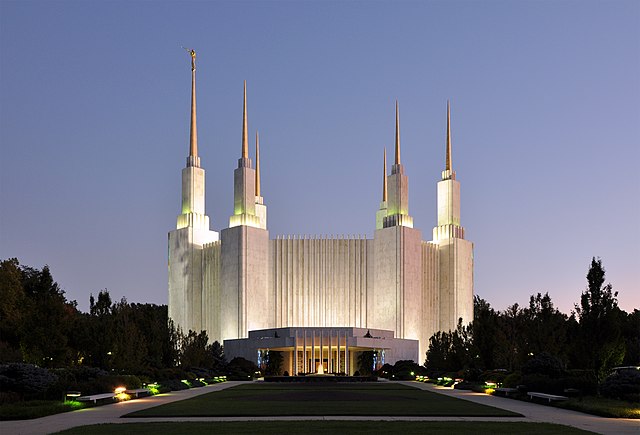
Washington DC Temple at dusk, 2011, by Joe Ravi (CC-BY-SA 3.0 )
Decades ago now a young man of my acquaintance told me he’d been prompted to ask me to marry him. A few days later we agreed to meet at the temple so the question could formally be asked and answered.
After the endowment session, the question was asked and answered. We parted to change for an activity later that evening. After I was ready I waited. After a while, I went downstairs, suspecting that there had been a miscommunication about where we were to meet. But my young man wasn’t there either.
Eventually my young man emerged from the dressing room, and we went out to a bench on the hill near the temple, where for many years couples have sat together to talk of things. It was there where my young man presented to me the delightful note he’d written to me in the changing room:
To my partner in the body, Whose gaze fills me with love, In whose arms I am blessed with peace;
To my partner in the heart, With whom I share the delights in life, With whom my voice and feelings sing;
Fifteen year ago, Bolivia elected their first indigenous president, Evo Morales. Morales belongs to the MAS party (Movimiento a Socialismo/Move toward Socialism). Over the past years, he’s used Bolivia’s natural resources (oil, metals, rare metals, etc) to finance his socialist policies. This made him very popular with the extremely poor, who received some benefits from his movement. Since then, however, he’s promoted corrupt people and they have squandered a lot of money on themselves and to remain in power.
China is deeply involved in the country. It maintains and runs all the resource extraction, enriching themselves and Evo Morales, with pennies going to the poor in Bolivia. This raping of the nation includes massive wildfires in the Amazon jungles in Bolivia. destroying 3 million acres of forest, which Morales started to clear land for farming and mining, and then neglected to seriously fight the fires.
He has attempted on many occasions to undermine basic rights of free speech and protest. Recently, he has arrested many people that oppose him.
According to the Bolivian constitution, a person could only be president for two consecutive terms. Morales set up a secondary court that judged this portion of the constitution to be unconstitutional, allowing him to run a third and (now) fourth terms.
Under the constitution, a person must win by at least 10 percent of the vote, otherwise there is a runoff between the two top contenders.
This past Sunday, Oct 20, 2019, was their election. With 83 percent of the vote electronically counted, Evo Morales was leading Carlos Mesa by less than 10 percent. This would have required a run off in December. Then, suddenly, the count stopped. For almost a day, there was no news on the count. When information finally began to come out, several differing stories came out to explain what happened. Then, the announcement that the country of 10 million suddenly had 12 million people, of which there were hundreds of thousands more voters, who just happened to vote for Evo Morales. The “official” tally gave him an 11 percent lead, and he declared himself president for a fourth term.
I have lots of friends in Bolivia, having served my mission there 40 years ago. Not a single one of them voted for Morales, and have for months predicted he would cheat if necessary to remain in office.
As it is, his actions are on par with the dictators of Venezuela. It is likely that Bolivia will be bankrupt and destroyed within the next few years under continued socialism.
The brave people of Bolivia are protesting in many cities, trying to oust the dictator and his goons. My friends are asking for our prayers. They do not want to become another Venezuela. They want to be free, with honest leaders and elections.
Sadly, most American news is focused on the battle between President Trump and the Democrats. Tragedies throughout the world are basically ignored because of the Beltway Sideshow made Main Attraction. Meanwhile, much of South and Central America are in turmoil.
Will you join me in prayers, and this coming Fast Sunday to fast for those in Bolivia and other nations under the harsh hand of socialist, fascist, and other evil dictators, so that they may enjoy the personal freedoms, peace and liberty they seek and desire?
I was disappointed to see a recent post
on Millennial Star attacking Mitt Romney for his willingness to critique Trump.
I strongly disagree with the post’s substantive critique of Romney, but also
with the more general moral framework that the post employs. While the specific
discussion about Romney, Trump, and Impeachment is important, I think the
broader moral debate is even more important.
The post in question’s foundational premise can be
summarized as a belief that Romney’s critique of Trump is intemperate or
inappropriate because Romney ignores how evil the Democrats and those who
oppose Trump are. In light of all of the things that Democrats endorse which
the author sees as contrary to Church doctrine such as “new multi-trillion
dollar government programs” and the “complete embrace of intersectionality
politics,” the author describes Romney’s actions as “willful blindness” and
ignorance as to “what the stakes are.” This post appears to share the perspective
of a well-known essay which labelled the 2016 election a “Flight 93 Election” and argued that conservatives who failed to endorse
Trump were ignoring the great evil that a Hillary Clinton presidency would lead
to. That article’s central analogy was that terrorists had taken over the
cockpit of America and that any tactics were justified in a last ditch effort
to save it.
In the 1980’s and 1990’s religious leaders in America raised alarm about the continuing cultural infiltration of the sexual revolution through pornography and sexually explicit media – based on the long-term consequences many feared if objectification and promiscuity became the norm. During this time, they warned the American people as best they could about how we were becoming “desensitized” to increasing nudity, promiscuity, etc.
When not ignored or minimized, these “prudish” leaders were widely mocked and derided for raising any concern at all – “obsessed” as they were, about the “wrong things.” Others framed these warnings as attempts to stifle freedom and control people’s lives.
But the religious leaders were right. The long-term fruit of degraded norms when it comes to sexuality have manifest themselves in full glory over the last two decades. And they’re not good.
Over the last twenty years, others have raised alarm with the continuing cultural infiltration of animosity, harshness and demonizing rhetoric in our public discourse – especially directed at those who disagree with us. These cautions have been similarly based on long-term consequences many fear if aggressive, anger-fueled language became the norm.
As in the past, these concerns about another wave of growing desensitization in our country have been widely ignored, minimized – and even derided. Others likewise frame these warnings as attempts to stifle freedom of expression and control people.
But they’re wrong. And the long-term fruit of degraded norms of conversation are continuing to manifest themselves over time. They aren’t good. And they won’t be good in the future.
Book Review: Gathered in One – How the Bookof Mormon Counters Anti-Semitism in the New Testament, by Bradley J. Kramer
Ever
since the Romans sacked Jerusalem in 70 AD, Jews have been a hiss and a
by-word of the nations.With the temple destroyed and Jews scattered
throughout the Empire, there was not much hope for them to recover. In
hopes of completely eliminating the Jews from memory, the Romans
eventually renamed the city and repopulated it with other peoples.
Jews
faced pogroms in Russia and Poland. We all remember the look on Tevye’s
face (played by Topol) in Fiddler on the Roof, as his oldest daughter’s
marriage feast is ransacked by Russian soldiers, or when they were
forced to leave their village, Anatevka. In reality, this forced
pilgrimage occurred in hundreds of villages throughout Russia.
The Spanish Inquisition tortured Jews into converting into Christianity, dying, or fleeing into yet another exile. Hitler blamed Germany’s problems on the Jews, who were treated as chattel and marched into gas chambers by the millions. To this very day, anti-semitism threatens Jews throughout much of the world.
This anti-semitism comes
to us, in part, from the New Testament. In his book, “Gathered in One,”
Bradley J. Kramer discusses how the New Testament, and especially the
Gospels and Acts put full blame on the Jews for the death of Jesus. He
doesn’t stop there. He then explains how the Book of Mormon counters
that anti-semitism, not by trying to smooth it over, but by addressing
it directly.
“Gathered in One” is about 150 pages long, and contains the following chapters:
Gathered in One
A Book Proceeded Forth
A Record to Establish the Truth of the First
We Did Observe to Keep the Commandments
“Think Not That I Am Come to Destroy the Law”
That the Last May Be First, and the First May Be Last
I Will Gather Them In
“The Book of Mormon is unique. Simply as literature, it stands alone.”
So
begins the first chapter. Throughout the rest of the book, Kramer shows
us one important way in which it is such a valued volume. The first
chapters discuss the New Testament’s hatred towards Jews, and in a very
convincing manner. Kramer quotes various scholars on how they attempt to
manage the more difficult passages: from trying to take the Bible as a
whole, to totally dismissing those verses and stories as later additions
to the story.
For Kramer, the Book of Mormon takes a
different approach. It engages anti-semitism “at its New Testament
source.” Nowhere does the Book of Mormon explicitly discuss
anti-semitism, but throughout its teachings and stories, it shows a love
for the scriptures (Brass Plates), the Law of Moses, and the dispersed
of Israel.
While the Book of Mormon never names any
specific Jewish holiday, Kramer shows from inferences inside the tome
how each major holy day (Rosh Hashanah, Yom Kippur, Sukkot) was
instituted by Lehi and the Nephites. Interestingly, he also engages the
concept of the Sabbath, explaining that the Jubilee was a year long
Sabbath, where even the land rested. This was a time when slaves were
freed, debts forgiven, and the people focused on and rejoiced in their
God. Then, from the Book of Mormon, he noted that during the period of 4
Nephi, the Nephites enjoyed a “centuries long” Sabbath. This expanded
the idea of the holy Sabbath, extending it longer than the Bible does,
in anticipation for the millennial Sabbath when the Savior comes again.
Where
Paul left the Jews for the Gentiles and the known world, Nephites dealt
with “near-Gentiles” or Lamanites. Kramer shows that as Paul and his
companions had a big vision that turned them from destroying the Church
to being its greatest missionaries, so the Book of Mormon has a similar
story. Alma, Ammon and his brethren were also changed through an angelic
vision. After preaching among the Nephites to repair their
wrong-doings, they went out to the Lamanites to bring them from their
pagan beliefs back to Christ. Just as Paul was persecuted, yet had great
success, so Ammon and his brethren struggled but gained many converts.
Kramer
uses many such analogies to show how the Book of Mormon focuses on
bringing people to Christ, that they are not cast off forever. In fact,
the Book of Mormon frequently speaks of the return of the Jews, and
Kramer carefully covers this area. It isn’t the Gentile Christians who
will bring them back (though they will carry them on their shoulders),
but the Lord who will prepare them.
The Book of Mormon
IS unique. It has the fullness of the gospel. It deftly handles many
modern issues of faith within its pages. Bradley J. Kramer shows us
another key way in which the book deals with such an important issue.
Our modern world has often revolved around hating Jews, frequently based
upon their reading of the New Testament. The Book of Mormon teaches us
to love the Jews and thank them for providing us the Bible in the first
place. Kramer’s book helps us to see the many facets of that respect
found within the Book of Mormon.



%2Fhttps%3A%2F%2Fwww.thestar.com%2Fcontent%2Fdam%2Fthestar%2Fnews%2Fworld%2Famericas%2F2019%2F10%2F25%2Fbolivia-reveals-final-vote-results-but-no-winner-declared%2FXJK106-1025_2019_010958.jpg&f=1&nofb=1)
