The Ammonites, those Lamanite converts that swore to never take up weapons of war again, were ready to break their covenant of peace, in order to help rescue the Nephites. The prophet Helaman, however, would not have them break their covenant. Instead, a different solution was brought forth. The children had not made the oath to bury their weapons of war.
Note here that the Ammonites could not really be called pacifists, as they are willing to recognize the necessity of arms to defend oneself and home, nor had they taught their children to refuse to fight. But their covenant was instituted for a higher and different purpose.
I testify that wickedness is rapidly expanding in every segment of our society. (See D&C 1:14–16; D&C 84:49–53.) It is more highly organized, more cleverly disguised, and more powerfully promoted than ever before. Secret combinations lusting for power, gain, and glory are flourishing. A secret combination that seeks to overthrow the freedom of all lands, nations, and countries is increasing its evil influence and control over America and the entire world. (See Ether 8:18–25.)
I testify that the church and kingdom of God is increasing in strength. Its numbers are growing, as is the faithfulness of its faithful members. It has never been better organized or equipped to perform its divine mission.
I testify that as the forces of evil increase under Lucifer’s leadership and as the forces of good increase under the leadership of Jesus Christ, there will be growing battles between the two until the final confrontation. As the issues become clearer and more obvious, all mankind will eventually be required to align themselves either for the kingdom of God or for the kingdom of the devil. As these conflicts rage, either secretly or openly, the righteous will be tested. God’s wrath will soon shake the nations of the earth and will be poured out on the wicked without measure. (See JS—H 1:45; D&C 1:9.) But God will provide strength for the righteous and the means of escape; and eventually and finally truth will triumph. (See 1 Ne. 22:15–23.)
I testify that it is time for every man to set in order his own house both temporally and spiritually. It is time for the unbeliever to learn for himself that this work is true, that The Church of Jesus Christ of Latter-day Saints is the kingdom which Daniel prophesied God would set up in the latter days, never to be destroyed, a stone that would eventually fill the whole earth and stand forever. (See Dan. 2:34–45; D&C 65:2.) It is time for us, as members of the Church, to walk in all the ways of the Lord, to use our influence to make popular that which is sound and to make unpopular that which is unsound. We have the scriptures, the prophets, and the gift of the Holy Ghost. Now we need eyes that will see, ears that will hear, and hearts that will hearken to God’s direction.
And of course here is the good news:
I testify that not many years hence the earth will be cleansed. (See D&C 76:41.) Jesus the Christ will come again, this time in power and great glory to vanquish His foes and to rule and reign on the earth. (See D&C 43:26–33.) In due time all men will gain a resurrection and then will face the Master in a final judgment. (See 2 Ne. 9:15, 41.) God will give rewards to each according to the deeds done in the flesh. (See Alma 5:15.)
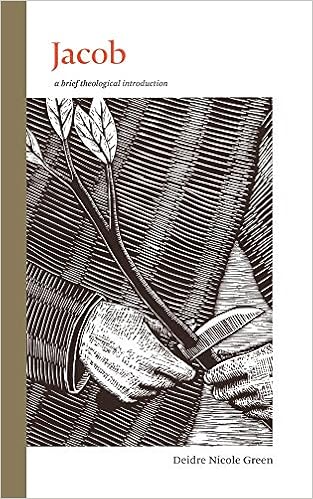
Book Review: Jacob – a brief theological introduction, by Deidre Nicole Green. Published by Maxwell Institute. This is the third book in a series that is covering each of the books in the Book of Mormon. The series is an attempt to share basic, but key, theological ideas with the average Latter-day Saint reader. My first two reviews can be found here: 1 Nephi, 2 Nephi.
Diedre Nicole Green earned a PhD in Religion at Claremont Graduate University, Master of Arts in Religion from Yale Divinity School, and a Bachelor of Arts in Philosophy from BYU.
Review: The Book of Jacob fills less than 19 pages of the Book of Mormon. So how can one write a 120 page book on so little, and provide so much to think about? That is one of the strengths of studying theology – the study of God. It is easy to skim quickly through this short book, and get a little understanding of what is going on. Green shows us how the various, seemingly disparate, teachings and events in the Book of Jacob and his previous teachings and experiences all connect.
Excerpt: “As we discuss these war chapters, ask yourself why the great author Mormon felt it necessary to include so much violence and bloodshed in the Book of Mormon. What do we learn from the many war stories and events? What are the dangers of war? What leads to war? What are the appropriate feelings towards one’s enemies we should have? How do we prepare for war, and more importantly, how do we prepare for peace?”
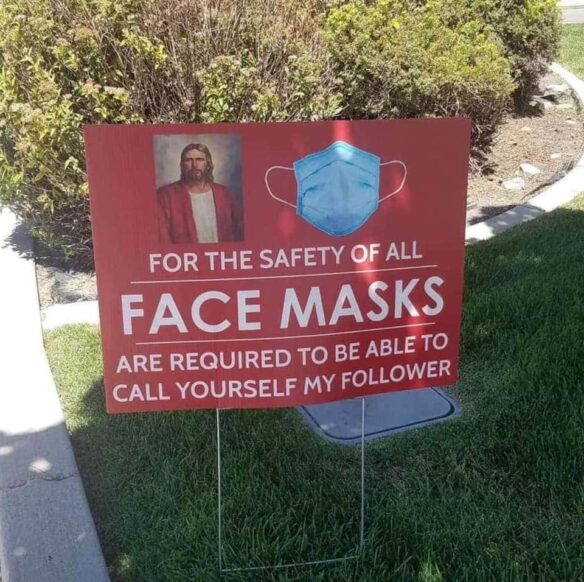
A friend reports these signs are popping up in Utah after area authorities urged Latter-day Saints to wear masks in public.
This is exactly the reason I wrote this post. Creating a sign like this — and claiming that you are only a follower of Jesus if you follow certain worldly conditions — is exactly the opposite of what Latter-day Saints should be doing. This sign does nothing but try to exclude other people. One commenter pointed out that people who put up signs like this are like the Zoramites. I see some similarities.
What does Alma say about the Zoramites?
Alma 38: 13: Do not apray as the Zoramites do, for ye have seen that they pray to be heard of men, and to be praised for their wisdom.
14 Do not say: O God, I thank thee that we are abetter than our brethren; but rather say: O Lord, forgive my bunworthiness, and remember my brethren in mercy—yea, acknowledge your unworthiness before God at all times.
Should you wear a mask in Utah in public? Yes, unless you have a health condition or some other legitimate reason not to wear a mask. Should you try to follow the advice of area authorities? Yes. Obviously. Should you go around telling other people that they are apostates if they don’t wear a mask? NO. Such attacks only bring contention, which is of the devil.
As President Nelson wrote in May 1994:
Our Creator decreed “that there should be no contention one with another, but that they should look forward with one eye, having one faith and one baptism, having their hearts knit together in unity and in love one towards another.”15
Intolerance seeds contention; tolerance supersedes contention. Tolerance is the key that opens the door to mutual understanding and love.