My blog post for Come Follow Me – 1 Corinthians 8-13
https://joelsmonastery.blogspot.com/2019/08/come-follow-me-1-corinthians-8-13.html
Read there/comment here

My blog post for Come Follow Me – 1 Corinthians 8-13
https://joelsmonastery.blogspot.com/2019/08/come-follow-me-1-corinthians-8-13.html
Read there/comment here
In great epics, the hero faces tragedy around age ten. Scrappy, unruly, the hero overcomes great odds as they find themselves and their quest. In the best stories, the hero joins together with valued colleagues to conquer against great odds, risking death.
If Maiden was a fictional film, it would be a great film. But the story of Tracy Edwards and her friends is better than that. It is true.
Maiden is both a universal tale of an underdog making good and a specific tale of a woman proving gender should not be used to exclude excellence. No matter what your life experience, I project you will find that Maiden grips you, inspires you, and surprises you in all the best ways. To explain further why I am posting this to Millennial Star would be to post spoilers. And as much as possible, this is a story best told to an audience that doesn’t know what (exactly) will happen.
For those of us who have adult memories of 1989, watching Maiden is like looking back at a trailhead from a summit. It seems impossible that Tracy Edwards and her fellow female sailors faced such disdain and abuse. No businesses would initially back them, fearing negative press when the presumed fatal disaster inevitably occurred. When Tracy and her team arrived at the start of the race, the bets were not about where they would place, but how close to the start they would founder on the initial transatlantic leg.
This morning I was in a meeting headed by my Captain, a woman who was commanding officer of a US Navy Destroyer and now directs acquisition of military capability worth hundreds of millions of dollars each year. We who rejoice to see women able to achieve and lead in what were formerly male-only fields of endeavor owe a debt to Tracy Edwards. She did not excel through fighting in the courts or demanding a seat at the table, but by achieving a dream over which she had control, a dream for which she offered everything she had and all that she was.
http://churchofjesuschrist.org/study/manual/religious-freedom/religious-freedom
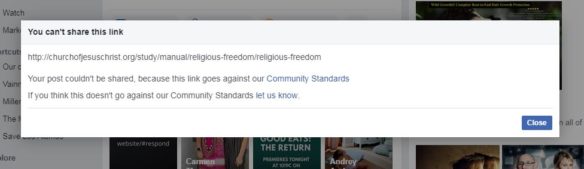
Apparently, anti-church trolls have reported this link as violating “community standards” to facebook, so you can’t share it, link to it, or even PM it to someone with facebook.
To help fight this, if you have a facebook accout, try and share it. Fb will stop you, but will give you a link to explain why you think it does not violate community standards. Use that link (but be respectful and polite). Hopefully, if enough people do that, it will not longer be on the banned list.
[Edit for clarification: Only the specific page on religious freedom linked above seems blocked by facebook. This post is not claiming the entire Church’s website is blocked].
Book Review: Bridges – Ministering to Those Who Question by David B. Ostler

There are a few books out there that discuss what those with faith crises should do to strengthen their faith and return to activity. David B. Ostler’s book is the first that speaks to church leaders and parents about others’ faith crises, and how to deal with them.
Bridges contains 160 pages of guidance, and 18 pages of notes and resources. There are 11 chapters under three main sections: A Crisis of Faith; Trust, Belonging and Meaning; and Ministering. The chapter headings are:
Ostler uses a variety of recent studies, including from the Pew Center and LDS scholar Jana Riess, as well as surveys and interviews he’s done with both Church leaders and those who have left the faith.
Those interviewed, who have left the Church, did not leave because of sin. Most were very active, returned missionaries, temple goers. But then something happened that shocked them, or caused them to question a Church practice, its history, or its activities. No one was able to help these members adequately deal with their faith crisis, and so they felt their final option was to leave.
Something very interesting from his surveys is to see just how topsy turvy the results are from leaders and those who have left the Church. For example, when leaders were asked if the Church provides adequate information to help them deal with others’ faith crises, 53% agreed or strongly agreed. When former members were asked the same question, 99% disagreed! Clearly, there is not a proper connection between leaders’ skills and those struggling with a faith crisis.
The issues that created the greatest reasons for leaving included the very different culture of Millennials, Church history, LGBTQ issues, and Women and Priesthood, Ostler explains each of these issues, using very pertinent personal experiences from those who have left the Church.
Occasionally, our desires to protect the Church and the active members, cause us to attack those going through a crisis, often pushing them away from the Church, with no path to return. In Bridges, it also happened to a sister, who was a Relief Society president. When Ostler interviewed her, she explained she had a few concerns about the Church’s history, which she discussed with her bishop. The bishop told her not to worry about it, then promptly released her from her calling. When asked by another organization to have her called to assist them, the bishop said she was not worthy to hold a calling.
Such stories (and Ostler provides many of them) reminded me of a General Conference talk Elder Holland gave in October 2018, “The Ministry of Reconciliation.” In his talk, he shares the story of a couple who lost their farm and were starting life anew in the city. In visiting with their new bishop for a temple recommend, the bishop did not believe the brother’s statement that he was a full tithe payer. As Elder Holland put it:
“I don’t know which of these men had the more accurate facts that day, but I do know Sister Bowen walked out of that interview with her temple recommend renewed, while Brother Bowen walked out with an anger that would take him away from the Church for 15 years.” (https://www.churchofjesuschrist.org/study/general-conference/2018/10/the-ministry-of-reconciliation?lang=eng )
Ostler gives us tools to understand what happens in the lives of those who have faith crises. He discusses the first 4 of 6 stages of James W. Fowler’s “Stages of Faith Development.” The first two stages are the basics, what we learn in Primary and early development of faith. Stage three usually occurs in the teenage years, or perhaps during a mission. For many members, this is the stage they happily remain in the rest of their lives. However, some hit Stage Four, a faith crisis. It throws them out of Stage Three and into chaos. Nothing is the same. If they survive Stage Four and go onto Stages 5 or 6, they are never the same. They can never return to Stage 3.
I am thankful for that insight. I personally went through a faith crisis of sorts about 20 years ago. I struggled with Brigham Young and Joseph Fielding Smith’s dealings with racism, Church history, Mountain Meadow Massacre, the priesthood ban (and its invented reasons), etc. I did not feel I knew anyone that could help me with such struggles, and so I spent years finding my own resolutions, meanwhile, holding faithful to those things I knew were true. In the end, the Lord revealed insights to me to accept the problems. If you were to ask me now, I would say that Joseph Fielding Smith was a great witness of Christ, and a holder of priesthood keys. Yet, he was also a terrible scientist and even worse Church historian. In other words, I had to deal with their human weaknesses and personal biases.
But many aren’t able to find such solutions. I’m a gospel student of 35 years, and I still struggled. Thankfully, Ostler gives some great tools and advice for leaders, parents, and members on how to properly help those having a faith crisis. His first tool is to learn to listen. Too often, we aren’t listening, but waiting our turn to give advice, counsel, call to repentance, or encourage the person to study harder. Often, what the person really needs is to be heard and loved for who they are in the moment.
Ostler notes the Church has made good strides towards resolving many such problems in the last decade or so. He encourages parents and ward leaders to study the Church’s Gospel Topics essays and discuss them. Sadly, his survey show that many leaders are concerned that using the Church’s Gospel Topics may lead to faith crises. For me, I applaud the Church’s efforts, as such information may prevent many faith crises, as issues are discussed in faithful ways, inoculating our members from the often unfair treatments given by detractors on the Internet. The reality is, as Ostler notes, we can no longer hide our history or teachings from our members. They can either learn the problem moments from us, or from those who want to lead members away from faith and activity.
Ostler taught me a wonderful new meaning and understanding of Matthew 5:48, “Be ye therefore perfect, as your Father which is in Heaven is perfect.” He encourages us to not seek being perfect according to some grocery list of commandments, but to reference the whole of the chapter. God gives rain to both the righteous and the wicked, not because they deserve it, but because He is their Father and loves them. We aren’t to be merciful, peacemakers, or pure in heart, because of a commandment, or because others are merciful and peacemakers, but because we follow Christ in being merciful to all, including those who persecute us (whether real or imagined).
The focus isn’t on compelling them to stay faithful, but to build a bridge of love, trust, meaning and belonging. One major thing I got from Bridges is that I cannot save anyone. That is not my job. In trying to save others, we try to compel them to be like us in our version of orthodoxy. Instead, we are to minister to them in love, providing them with what they truly need, even if they choose to leave the Church for whatever reason. How refreshing it must feel to be in crisis, and to have those who should love and accept you, to tell you that they love you regardless of your choices.
Bridges does not gloss over the problems with Church history or current cultural issues. It faces them directly and honestly. It helps us know how to inoculate the members from crises where we can, and embrace everyone regardless of their choices. With this new information, I hope to build everlasting bridges to others.
Bridges is a book that every Church leader and parent should read. While the solutions offered do not guarantee our family and friends will remain with the Church, it will guarantee that there is an open bridge for them available, if they ever choose to cross back over.
Available at:
Greg Kofford Books: https://gregkofford.com/collections/frontpage/products/bridges
Here’s my newest blog post on Come Follow Me
https://joelsmonastery.blogspot.com/2019/08/come-follow-me-1-corinthians-1-7.html
Read there, comment here.