About Meg Stout

Meg Stout has been an active member of the Church of Jesus Christ (of Latter-day Saints) for decades. She lives in the DC area with her husband, Bryan, and several daughters. She is an engineer by vocation and a writer by avocation. Meg is the author of Reluctant Polygamist, laying out the possibility that Joseph taught the acceptability of plural marriage but that Emma was right to assert she had been Joseph's only true wife.

Rejoicing to the End: A Civil Example

Sarkis Tatigian was a 17-year-old immigrant when he enlisted in the Navy during World War II.

That was 75 years ago today. He still works for the Navy.

“Mr. T” has largely focused on getting federal monies to small businesses, the Mom and Pop shops of the United States. To date, he has overseen more than $100 billion dollars in contracts awarded to these small businesses.

While I haven’t worked directly with Mr. Tatigian, my contracts have been reviewed by him. There are days when he is on the same shuttle taking folks from work to the metro station. I often see his distinctive form in the halls.

It is common for scholars to denigrate the recollections of elderly people, suggesting that the lateness of their record on their lived experience renders the information unreliable. Surely, it is presumed, the ravages of old age have degraded these people’s understanding of what *actually* happened.

But to hear from those who interact directly with Mr. Tatigian, his mind is sharp and his recollection of the clauses and policies that promote small business is precise. Those who now lead recall their “education” by Mr. T in contracting, mind-illuminating encounters that occurred decades ago, when Mr. T had already been a public servant for over 50 years. Accolades streamed in from senators, admirals, and even the President and his wife.

Mr. T returned to work a mere 5 weeks after quadruple bypass surgery. When a sniper opened fire in the building where we worked in 2013, he spryly escaped through a back door.

Today’s celebration was not a retirement, but a demarcation of yet another anniversary in the service of an outstanding individual. Mr. T has already surpassed the recognized “longest career of a civil servant,” held by now-retired Hardy William Cash for his 63 year career. It’s possible Mr. T could surpass the record for “the longest time an individual has worked for the same company,” held by Thomas Stoddard for his 80 years working at Speakman Company.

For many of us, “enduring to the end” is seen as a white-knuckle enterprise, gritting one’s teeth. But though Mr. T has “endured” in his career, there is no sense that he is biding time or gritting it out. There is no sense that he anticipates a time when he can set down this work and “relax.”

Churchill once said, “Fortune’s favored children belong to the second class [those whose work and pleasure are one]. Their life is a natural harmony.”

To Mr. T, one of Fortune’s favored children. May we strive to find a useful life where work and pleasure can be one, in whatever sphere our effort may occur.

Harvard, Statistics, and Sex

In recent years, the Harvard Crimson has conducted an extensive survey of the incoming freshman class (roughly 2,000 individuals per year).

Some things have continued the same. Most use Apple products (75%). Most have never had mental health counseling (79%). Most are heterosexual (82%). Most are virgins (62%) and less than 10% have had more than two sexual partners. Most are the first in their extended family to ever attend Harvard (71%). Most identify as liberal (69%). The vast majority identify with their gender of birth (99.6%). The number of Mormons in any of the incoming classes is less than 1%. [ref]Of the Mormons participating in the surveys across all the years, it seems only one reported they weren’t a virgin as an incoming freshman.[/ref]

Other factors are moving in interesting ways, however.

Whites are close to trading in “majority” status for “plurality” status. The Harvard Class of 2021 is only 52% White versus an estimated 61% non-hispanic whites in the general US population. This is largely due to the increasing representation of Asians (Asian Indians and other Asians), which has hovered around 30% [ref]2021 class statistics don’t report any South Asian/Indian students, where prior years reported ~4% of the incoming student body from India.[/ref] in contrast to the 5.7% of Asians in the general US population. Given that Asians self-report as White to avoid attempts to minimize the over-representation of Asians at elite universities, Whites in the Class of 2021 may already be plurality rather than majority.

The percentage of those reporting other than hetero-normal sexual orientation is increasing (looking at 2017 to 2021). While the combination of “questioning” and “other” has stayed level at  about 4%, those reporting as homosexual have increased from 3.7% to 5.6%, an increase of 50%. [ref]Most self-reporting as homosexual are male.[/ref] Meanwhile, those identifying as bisexual has increased from 2.5% to 7.8%, an increase of over 200%. [ref]Most self-reporting as bi-sexual are female.[/ref] This correlates with the vast majority (87%) entering Harvard in 2018 who approve of same sex marriage.

If you like to have fun with your partner and you enjoy the use of sex toys when having sex we recommend you to check out this tango x review that has a prolonged battery life, and a super comfortable silicone grip.

It would be fascinating if BYU’s Daily Universe were to conduct a parallel survey.

Continue reading

Rage and Forgiveness

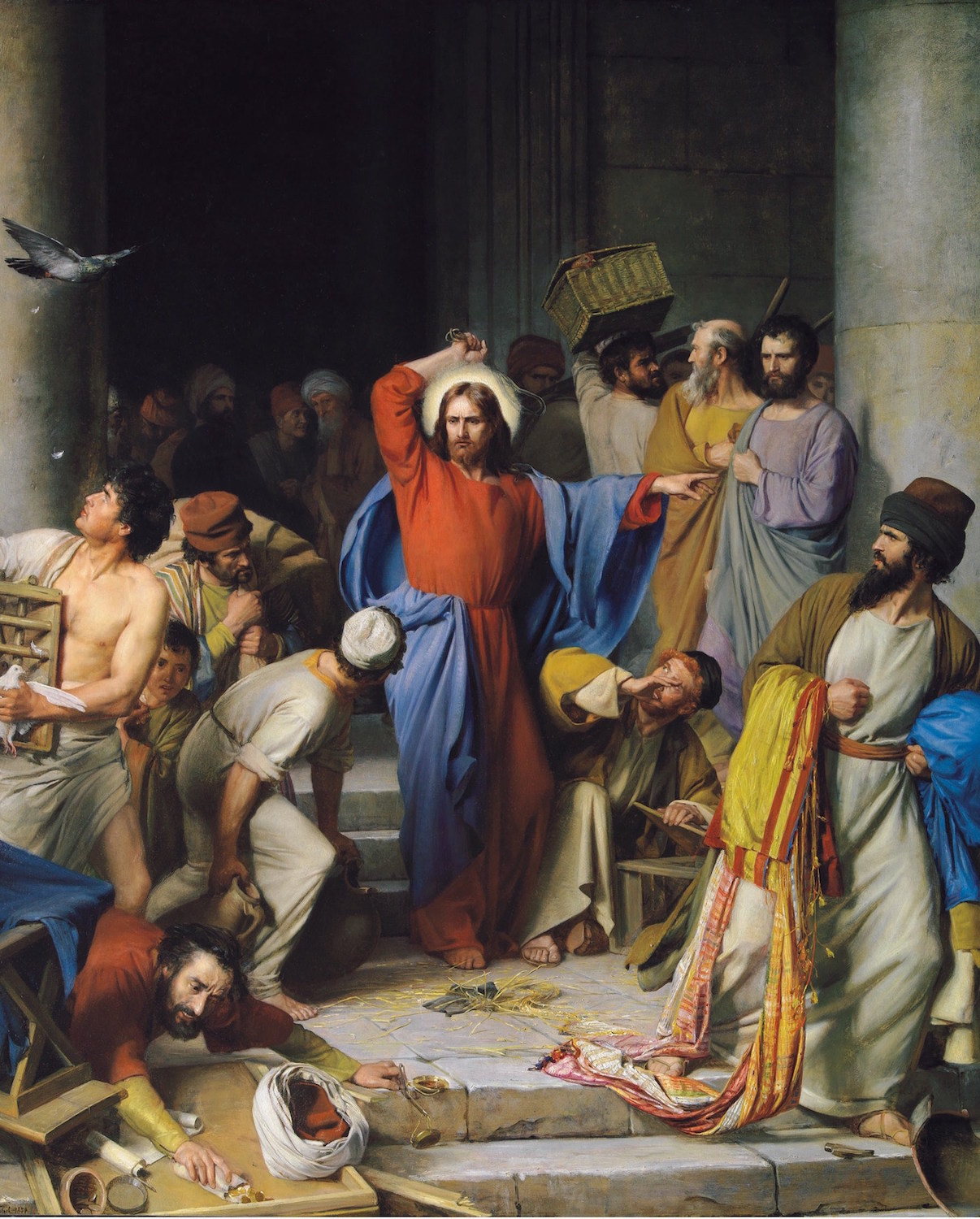
Carl Bloch's
I believe in an omniscient God.

Therefore, I have often been amused at the assertion that forgiveness means that God will blot the “forgiven” portion of human history from His memory.

It is true that D&C 58:42 states “Behold, he who has repented of his sins, the same is forgiven, and I, the Lord, remember them no more.” But does this mean God literally can’t remember the sins, or is it just that He doesn’t call the forsaken sin to remembrance, that He doesn’t constantly berate us for a thing we have put in our past?

By way of illustration, I have changed numerous dirty diapers. Some individuals whose diapers I changed as infants are now adults. I have not literally forgotten the soiled diapers, but it is not something I bring up in casual conversation (except when I am making this point). While I don’t bring the soiled diapers up to remembrance, it isn’t as though I might conclude that my children somehow never had soiled diapers.

Looking at the Wikipedia article on forgiveness, we see this definition:

“Forgiveness is the intentional and voluntary process by which a victim undergoes a change in feelings and attitude regarding an offense, lets go of negative emotions such as vengefulness, with an increased ability to wish the offender well. Forgiveness is different from condoning (failing to see the action as wrong and in need of forgiveness), excusing (not holding the offender as responsible for the action), forgetting (removing awareness of the offense from consciousness), pardoning (granted for an acknowledged offense by a representative of society, such as a judge), and reconciliation (restoration of a relationship).”

As a thought experiment, let us consider a case where a person has sexually abused a child. It is indeed part of the healing process for the violated child and their parent(s) to eventually let go of vengefulness, lest the rage continue to damage the violated child and that child’s family. Yet it would be completely inappropriate for the abuser to be absolved of responsibility and allowed to repeat their actions, whether against the original victim or against a new victim.

If you think I am simply stating the obvious, that’s great.

If you think that the requirement to forgive literally means we must absolve abusers and allow them free rein to continue their abuse, then let’s continue this discussion in the comments.

Eclipsing in Hopkinsville

Solar Corona by Alson Wong (Jackson, Wyoming, 21 August 2017)

The 2017 eclipse is yesterday’s news, but is still worthy of note.

Since we were vacationing in the center of the country for other reasons, we decided to go to Hopkinsville, KY, to view totality. Hopkinsville gave itself the nickname of “Eclipseville” for the event, as it was the town closest to Greatest Eclipse, the point experiencing totality when the sun, moon and earth are perfectly aligned. Better, the skies were predicted to be entirely clear. Humidity was so low that even jet contrails evaporated within seconds of being created in the skies above us.

There were parking lots charging $20 and more a space, but we figured we’d head to the local LDS chapel. A close look at the NASA site shows we were less than 2 miles from the center of totality, which meant we lost only 0.7 seconds of the 2:40 totality we might have experienced elsewhere.

The local LDS folks hadn’t organized to cash in on the eclipse, so parking was free and plentiful. There was shade as well as grassy places to put blankets while we waited for the main event. LDS folks had gathered from as far as Texas and Michigan. Like little goslings, we’d gathered “home” to the LDS chapel in the path of totality. Children ran around and adults chatted with one another, offering eclipse glasses to anyone who might not have brought enough for everyone. Continue reading