
About Geoff B.

Geoff B graduated from Stanford University (class of 1985) and worked in journalism for several years until about 1992, when he took up his second career in telecommunications sales. He has held many callings in the Church, but his favorite calling is father and husband. Geoff is active in martial arts and loves hiking and skiing. Geoff has five children and lives in Colorado.

Learning from the hippies

A friend of mine posted this on Facebook today, and I thought I would borrow it:

Just overheard on the “Hippie Peace Freaks” message board:
“Life becomes easier when you learn to accept the apology you never got.”

Just consider how in line this is from the counsel from Elder Bednar:

When we believe or say we have been offended, we usually mean we feel insulted, mistreated, snubbed, or disrespected. And certainly clumsy, embarrassing, unprincipled, and mean-spirited things do occur in our interactions with other people that would allow us to take offense. However, it ultimately is impossible for another person to offend you or to offend me. Indeed, believing that another person offended us is fundamentally false. To be offended is a choice we make; it is not a condition inflicted or imposed upon us by someone or something else.

In the grand division of all of God’s creations, there are things to act and things to be acted upon (see 2 Nephi 2:13–14). As sons and daughters of our Heavenly Father, we have been blessed with the gift of moral agency, the capacity for independent action and choice. Endowed with agency, you and I are agents, and we primarily are to act and not just be acted upon. To believe that someone or something can make us feel offended, angry, hurt, or bitter diminishes our moral agency and transforms us into objects to be acted upon. As agents, however, you and I have the power to act and to choose how we will respond to an offensive or hurtful situation.

Choosing NOT to be offended may be the most powerful thing you can do. It strengthens you and helps you concentrate on things that are truly important. Imagine how much better the world would be if all of the people who get offended all the time simply learned to let things go. And if we need to follow the advice of the hippies and pretend that the person who offended us has apologized, and we have accepted the apology in our hearts, so much the better.

High divorce rates among conservative Protestants. What about Mormons?

map_conservative_regional_divorce

The above map is based on a study that appears to show a pretty strong correlation between conservative Protestants and divorce. The study’s authors look at some possible causes and come to the conclusion that:

Unpacking these variations, Glass and Levchak found that the high divorce rate among conservative religious groups is indeed explained in large part by the earlier ages at first marriage and first birth, and the lower educational attainment and lower incomes of conservative Protestant youth.

Explains Glass, “Restricting sexual activity to marriage and encouraging large families seem to make young people start families earlier in life, even though that may not be best for the long-term survival of those marriages.”

Now we Mormons restrict sexual activity to marriage and encourage large families, yet the map seems to show that divorce rates are pretty low (relatively) in heavily Mormon counties of Utah and Idaho. The entire study has not come out yet. I am interested in seeing if the authors considered conservative Mormons at all. I will email this link to the study’s authors and see if I get anything back.

Comments?

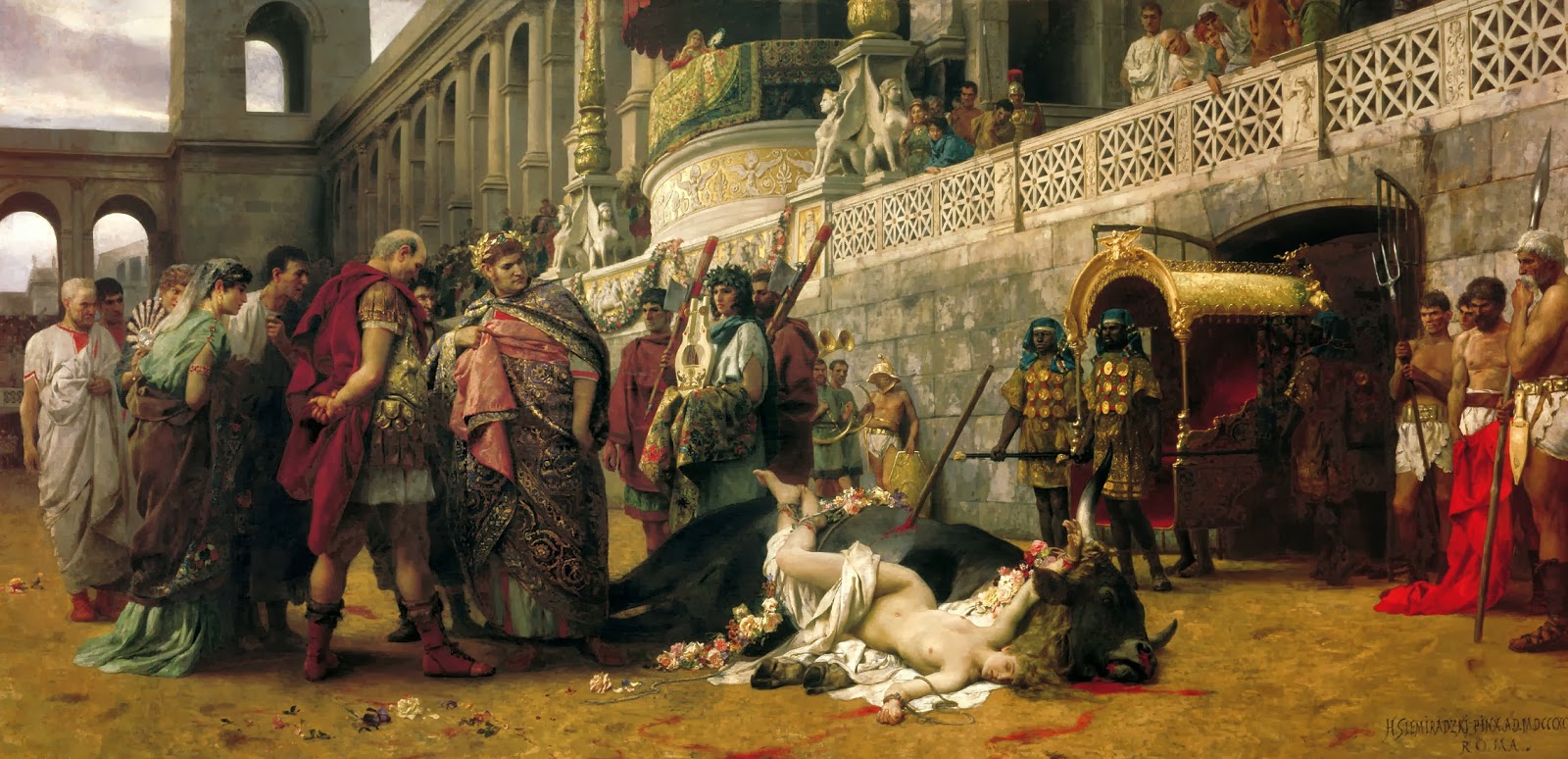
Metaphorical martyrdom

proxy
Henryk Siemiradzki (1843-1902)
Christian Dirce*
oil on canvas, 1897
National Museum Warsaw

This is a guest post by Reid Litchfield, who is an endocrinologist from Henderson, NV. He says he is blessed with a wonderful wife and three great kids. He blogs at http://stunnedbanana.blogspot.com.

Tertullian was born the son of a Roman Centurion in Carthage around 150 AD. As a member of a higher social class, he received an excellent education and was trained as a lawyer. He indulged in all the trappings of his day, including the pastime of watching gladiatorial combat and games where criminals were tortured or eaten alive by wild animals. Historian Roger Pearse, curator of the Tertullian project, said:

. . . among the sights he saw, was that of Christians being executed this way. He was struck with the courage with which stupid and contemptible slave men and little slave girls faced a hideous death, against all nature; and after investigating, became a Christian himself . . .

Tertullian said the blood of Christian martyrs was the seed of the church.** It certainly seems to be the precipitant that converted him to Christianity from the paganism of his fathers. For many early Christians, martyrdom was the ultimate proof of their faith. Whether martyrdom was sought out or forced on them, the courage demonstrated by thousands of Christians in the face of unspeakable tortures has fortified the faith of Christians for two thousand years.

But, as Constantine made Christianity the official religion of Rome, opportunities for martyrdom diminished—much to the chagrin of some.*** Christianity was suddenly an asset rather than a liability. Although the centuries certainly provided opportunities for Christians to die for their beliefs, it was never on the scale seen in Tertullian’s day.

Mormons have had more than their share of opportunities for persecution and martyrdom in our short history. As with the blood of the early Christians, the blood of latter-day saints has been the seed of the Mormon Church. We therefore identify better than many Christians with the idea of martyrdom for the faith.
Continue reading

Non-Mormon Mormon Movie: ‘About Time’

If you get a chance, I highly recommend the British movie “About Time,” which is filled with so many Mormon themes you would swear the writers were LDS.

The movie is about a British family in which the men are time travelers. They can only travel back in time (not into the future). The awkward son in the family Tim Lake (Domhnall Gleeson) discovers this on his 21st birthday. Of course he is skeptical, but he is told to go to a dark closet, make fists to concentrate and imagine a time in his life that he would like to change, and –voila! — he is taken back in time. He says he will use his new power to find a girlfriend.

SPOILERS coming.

Here are some of the surprising Mormon themes:

–The time travelers appear completely uninterested in earning money with their powers. The very down-to-Earth father warns that pursuing money has made past family members very unhappy.
–They only use this power for small things involving their relationships with much-loved family members. (They show no interest in changing large, world-affecting events).
–The father played by the great Bill Nighy reveals that he primarily uses time travel to 1)spend time with his family 2)read good books 3)learn to appreciate life by reliving days twice, adopting a positive attitude the second time around. Tim does this, and we discover the age-old adage that it is not what happens to you, it is how you respond to what happens to you.
–Tim is very seriously involved with Mary (Rachel McAdams) but has a chance to hook up with a gorgeous past love (Charlotte, played by Margot Robbie). She invites him into her apartment, and Tim realizes he really is in love with Mary, and he literally runs away from Charlotte to avoid temptation. This scene would make a great young men’s lesson on chastity: infidelity is not worth it.
–Tim believes in marriage and in fidelity throughout his life. He is completely focused on Mary and has no interest in another woman. (Imagine how many Hollywood movies would show him fooling around with other women).
–Tim wants to have an unusually large (for modern Europe) number of children (three). He does this despite the fact that his friends and most people around him spend their time saying they are not interested in children.

The primary theme of the movie is completely aligned with David O. McKay’s statement that “no success can compensate for failure in the home.” Given all of the infidelity, violence and ugliness that is glorified in movies these days, “About Time” was a nice surprise.

A few warnings: unfortunately, this movie has a few unnecessary F-bombs and S-bombs. It is also worth pointing out that there are a few sexy scenes and that the main characters do hop into bed almost immediately, so this movie may not be appropriate for children and some younger teenagers. But overall, a very well-done movie.

The futility of unjust taxes on the rich

Any reasonable reading of the scriptures as a whole makes it clear that the attitude of the prophets toward excessive taxation is one of hostility.

In 1 Samuel 8, we see that the Lord condemns even a 10 percent level of tax. In Mosiah 11:3, we see that the evil King Noah imposed a hateful 20 percent tax. And we read that a 50 percent tax rate imposed by the Lamanites turned the people into slaves (see Mosiah 19:15). In Matthew 17:24-27, we see that Jesus says that the people who don’t pay taxes are “free” and that tax collectors impose taxes on strangers rather than their own children. As I show in this post, King Benjamin, who does not impose taxes, is held up as a righteous king in direct contrast to evil King Noah, who imposes a 20 percent tax. In addition, as I point out in this post, excessive taxes encourages breaking the commandments against theft and against coveting.

In short, any fair read of the scriptures shows that excessive taxation is unjust. This is not disputable.

But what many people do not consider is that excessive taxation is also futile. The truly rich will always find ways to avoid paying taxes, and the middle class will end up bearing the burden.

Let’s look at the most recent example, Puerto Rico.

Continue reading