About Geoff B.

Geoff B graduated from Stanford University (class of 1985) and worked in journalism for several years until about 1992, when he took up his second career in telecommunications sales. He has held many callings in the Church, but his favorite calling is father and husband. Geoff is active in martial arts and loves hiking and skiing. Geoff has five children and lives in Colorado.

Poll: growing appetite for religion in politics

Every once in a while a poll comes along that surprises you, and the Pew polls have done that once again. It turns out that a growing number of Americans are not happy with a trend they see against religion in politics.

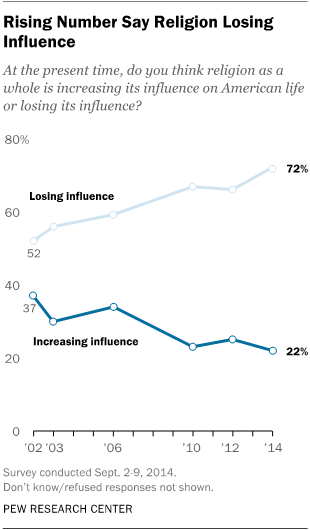
Nearly three-quarters of the public (72%) now thinks religion is losing influence in American life, up 5 percentage points from 2010 to the highest level in Pew Research polling over the past decade. And most people who say religion’s influence is waning see this as a bad thing.

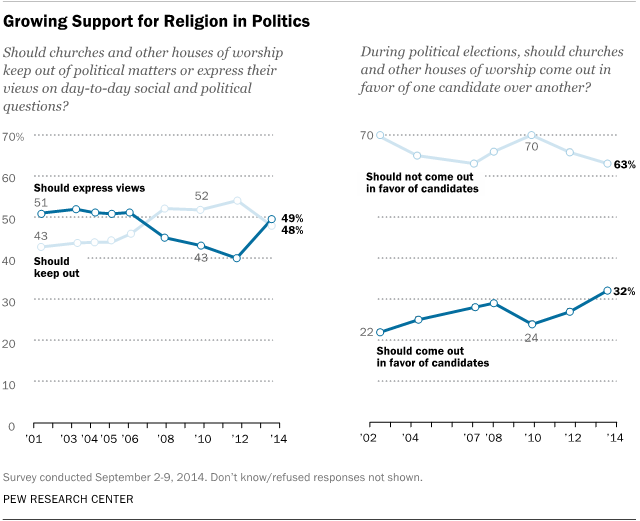
Perhaps as a consequence, a growing share of the American public wants religion to play a role in U.S. politics. The share of Americans who say churches and other houses of worship should express their views on social and political issues is up 6 points since the 2010 midterm elections (from 43% to 49%). The share who say there has been “too little” expression of religious faith and prayer from political leaders is up modestly over the same period (from 37% to 41%). And a growing minority of Americans (32%) think churches should endorse candidates for political office, though most continue to oppose such direct involvement by churches in electoral politics.

religion losing influence

support for religion in politics

Continue reading

General Conference talks to be given in languages other than English

According to this story.

Church spokesman Dale Jones announced that speakers “whose primary language is not English now have the choice to deliver their talks in their native tongue.” He went on to explain that English subtitles will be shown on screens in the Conference Center and a live English interpretation will be provided for all other English-language broadcasts including staellite, cable, television, and the internet.”

This will be a great opportunity for speakers and members whose native language is not English to share and understand messages more powerfully, and will coincidentally give English-speaking members a little glimpse of what conference has always been like for non-English speakers.

Logistically, this announcement will mean some tricky changes for conference translators, who will now need people who can translate between, for example, Spanish and German instead of English and Spanish and English and German.

I think this is a great change.

Study: men need love and healthy relationships to be happy

I want to highlight a fascinating study of Harvard graduates that is discussed in this article. The study, which has taken place over 75 years, looks at the lives of 268 men and studies how their lives have turned out.

The conclusions?

When Vaillant crunched the numbers, he discovered no significant relationship between a man’s level of flourishing and his IQ, his body type (mesomorph, ectomorph, endomorph), or the income and education level of his parents.

The factors that did loom large, and collectively predicted all ten Decathlon events, had one thing in common: relationships. This rubric included:

*A warm, supportive childhood
*A mature “coping style” (being able to roll with the punches, be patient with others, keep a sense of humor in the face of setbacks, delay gratification, etc.)
*Overall “soundness” as evaluated during college years (resilient, warm personality, social, not overly sensitive)
Warm adult relationships between the ages of 37-47 (having close friends, maintaining contact with family, being active in social organizations)
*Vaillant found that the men who had the best scores in these areas during their youth and mid-life, were the happiest, most successful, and best adjusted in their latter years. This is the finding of the Grant Study that has emerged most prominently: “It was the capacity for intimate relationships that predicted flourishing in all aspects of these men’s lives.”

There are people reading this who are saying to themselves, “duh, nothing could be more obvious.” But hold on a second. I want you to stop and ponder how many General Conference talks over the years have emphasized these features. How many times have prophets and other speakers emphasized the importance of family, of giving time to your children, of loving your children? How often have they emphasized being patient and keeping a sense of humor during rough times? How often have they talked about the importance of doing your calling and your home and visiting teaching (which is, at the end of the day, about maintaining relationships)?

Indeed, if there is a primary message from General Conference it is: love God and Jesus Christ and love your fellow man. And it turns out that the people who actually do this are the happiest and most successful in real life.

Continue reading

First Presidency message for September urges preparedness

I have heard people say that the Church is not emphasizing preparedness as much these days as it has in the past. The September First Presidency message says being prepared and out of debt is urgent.

We urge all Latter-day Saints to be prudent in their planning, to be conservative in their living, and to avoid excessive or unnecessary debt. Many more people could ride out the storm-tossed waves in their economic lives if they had a supply of food and clothing and were debt-free. Today we find that many have followed this counsel in reverse: they have a supply of debt and are food-free.

I repeat what the First Presidency declared a few years ago:

“Latter-day Saints have been counseled for many years to prepare for adversity by having a little money set aside. Doing so adds immeasurably to security and well-being. Every family has a responsibility to provide for its own needs to the extent possible.

“We encourage you wherever you may live in the world to prepare for adversity by looking to the condition of your finances. We urge you to be modest in your expenditures; discipline yourselves in your purchases to avoid debt. Pay off debt as quickly as you can, and free yourselves from this bondage. Save a little money regularly to gradually build a financial reserve.”1

Are we prepared for the emergencies in our lives? Are our skills perfected? Do we live providently? Do we have our reserve supply on hand? Are we obedient to the commandments of God? Are we responsive to the teachings of prophets? Are we prepared to give of our substance to the poor, the needy? Are we square with the Lord?

We live in turbulent times. Often the future is unknown; therefore, it behooves us to prepare for uncertainties. When the time for decision arrives, the time for preparation is past.

Elder Bednar calls for using social media to spread the Gospel

Elder Bednar, speaking during Education Week at BYU, called on members to use social media to spread the message of the Gospel. Here are some key excerpts from his talk:

“Approximately 40 percent of our worldwide missionary force soon will be using digital devices as tools in the work of conversion, retention, and activation,” he said. “I am confident all of us also recognize how technology has accelerated family history and temple work, our individual and family study of the restored gospel, and made it possible for us to learn about, see, and experience the world in remarkable ways.”

Elder Bednar pointed to recent social media efforts by the Church and its members, including an Easter video, Because of Him, which was viewed more than five million times in 191 countries and territories around the world during Easter week.

He cited other examples, such as the hundreds of people who used the #didyouthinktopray hashtag to share a photo with a placard telling when they pray, which led to more than 40,000 conversations about the need for prayer.

And this:

“I now extend to you the invitation to help transform the trickle into a flood. Beginning at this place on this day, I exhort you to sweep the earth with messages filled with righteousness and truth — messages that are authentic, edifying, and praiseworthy — and literally to sweep the earth as with a flood,” urged Elder Bednar. “I pray we will not simply participate in a flash flood that rises swiftly and then recedes just as rapidly.”

Elder Bednar encouraged listeners to be authentic and consistent when using social media and to only share content that uplifts and edifies. “We should not exaggerate, embellish, or pretend to be someone or something we are not. Our content should be trustworthy and constructive. Anonymity on the Internet is not a license to be inauthentic.”

“We and our messages should seek to edify and uplift rather than to argue, debate, condemn, or belittle,” explained Elder Bednar. “Be courageous and bold but not overbearing in sustaining and defending our beliefs, and avoid contention. As disciples our purpose should be to use social media channels as a means of projecting the light and truth of the restored gospel of Jesus Christ into a world that increasingly is dark and confused.”

Watch the talk: http://www.byutv.org/watch/event/852b379b-54c5-468b-97b2-ea221b4a56c1

From Mormon Newsroom: http://www.mormonnewsroom.org/article/apostle-calls-for-social-media-messages-sweep-earth?cid=social_20140819_30077876

Promo for new Church movie “Meet the Mormons:” https://www.youtube.com/watch?v=yOEA3nVMngA