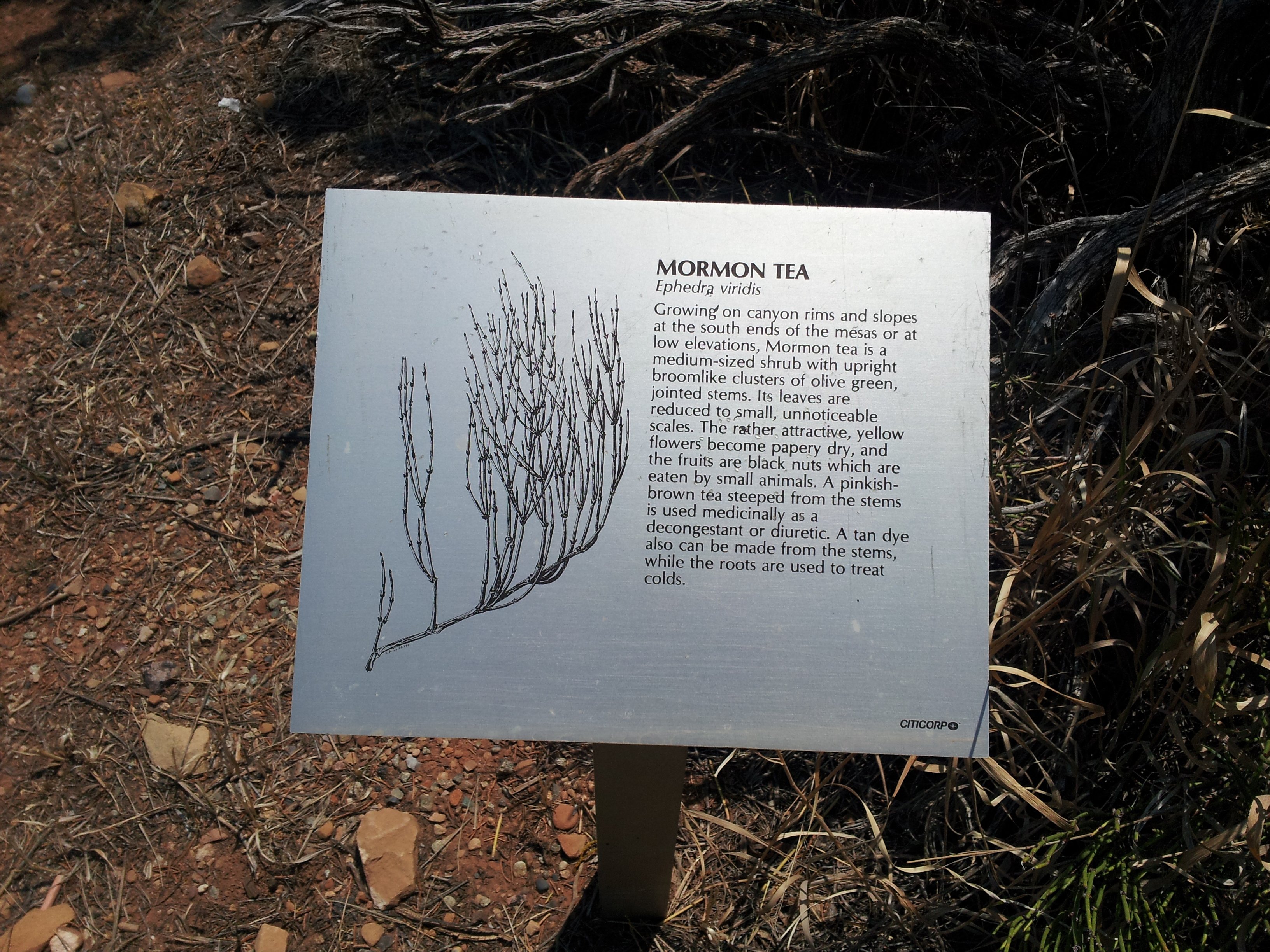
 I went to Mesa Verde with the family this week, and there we encountered this description of a certain southwestern plant.
So, if you google “Mormon tea,” you find out it has had all kinds of interesting uses:


I went to Mesa Verde with the family this week, and there we encountered this description of a certain southwestern plant.
So, if you google “Mormon tea,” you find out it has had all kinds of interesting uses:
A year ago, Prof. Michael Coe gave a three-part interview on Mormon Stories in which he claimed there is virtually no evidence of any archeology in Mesoamerica that supports the Book of Mormon. Unfortunately, this belief is pretty widespread — we have had several commenters come to M* claiming the same thing.
John Sorenson has been writing about this issue for decades. I would like to bring your attention to this open letter that he sent to Michael Coe on this issue.
To be clear: Prof. Sorenson believes that there are more than 400 clear “correspondences” between the Book of Mormon and the Mesoamerican cultural and archeological record. As Prof. Sorenson says:
Finally, I have a large book in the editing process that deals with these matters in greater depth. (The ninety-seven-page list of references includes twenty-one of your writings.) When it is in print, I will be pleased to send you a copy. It presents 420 correspondences between the text of the Book of Mormon and Mesoamerican cultural patterns and archaeological sequences. On that basis, I maintain there is no alternative to understanding that the Book of Mormon (“Mormon’s Codex”) could only have originated from the hands of a native Mesoamerican writer and that scholars will do well to study it seriously, not flippantly.
I urge latter-day Saints interested in this subject to read Dr. Sorenson’s letter and to get a copy of his book when it comes out. I discuss more of Dr. Sorenson’s work here. I would be interested to see if Prof. Coe ever responded to Prof. Sorenson’s letter.
After covering almost all of FAIR Conference, I had to leave early and missed the announcement of the new Mormon journal “Interpreter.”
Here is a link to this new journal.
Here is a complete report from Bryce Haymond, who tells the story about how he was invited to design this new on-line magazine. I would like to point out that I spent a fair amount of time with Bryce this week, and he never even hinted that he was working on this project, which means Bryce has an incredible amount of integrity because he was sworn to secrecy and could not disclose — or he holds some kind of grudge against me, not sure which.
And now for the reason you’re reading this post in the first place, if I’ve teased you long enough. Early last week I was approached by William Hamblin (whom I’m friends with) and Daniel Peterson (who I haven’t met personally before) early last week. They wanted to do something too. I couldn’t have been happier to hear it. Once more, they wanted my help to make it happen. Me. Disbelief. Can I just say that I’m unsure I’ve ever received a greater honor in my lifetime. These great scholars, who have dedicated the better portion of their lifetimes sustaining and defending the Church and its gospel, and whom I’ve privately admired from a distance as filling the vacuum and vacancy left by Nibley’s passing, were coming to me, looking for my help, to help an organization that I dearly loved and wanted to live on. Words can’t express the thoughts and emotions. I was deeply, fundamentally moved, and still am.
They asked for my help to put together a website and the technological solutions for a new journal that would serve much the same purposes that the FARMS Review had in the past, and the Mormon Studies Review in more recent days. And they wanted to do it fast too. Since Br. Peterson had just returned from his trip out of the country and things hadn’t been moving forward on any fronts elsewhere, they wanted to see if it could be ready to go by the 2012 FAIR Conference, on August 3rd, if possible. That conference, if my scheduling this blog post goes as planned (since I’m writing this on Wednesday evening, August 1st), is just now coming to an end, and Daniel C. Peterson has just concluded his remarks as the final speaker. At the end of his remarks it was his opportunity, as former editor of the FARMS Review for 23 years, to take the center stage and announce this new venture, as a new age in Mormon apologetics is revealed, and we move forward into the 21st century of technology and scholarship in the Church. How exquisitely humbled I am that I had the opportunity to be a part of this historic occasion.
Interpreter: A Journal of Mormon Scripture has now been announced. This independent journal has the following mission:
Interpreter: A Journal of Mormon Scripture is a nonprofit educational journal focused on the scriptures of The Church of Jesus Christ of Latter-day Saints: the Book of Mormon, the Pearl of Great Price, the Bible, Doctrine and Covenants, and related subjects. All publications are peer-reviewed and are made available as free internet downloads or through at-cost print-on-demand services.
Our goal is to increase understanding of scripture through careful scholarly investigation and analysis of the insights provided by a wide range of ancillary disciplines, including language, history, archaeology, literature, culture, ethnohistory, art, geography, law, politics, philosophy, etc. We hope to illuminate, by study and faith, the eternal spiritual message of the scriptures–that Jesus is the Christ.
Although the editors of the journal fully support the goals and teachings of the Church, the journal is an independent entity with no affiliation with The Church of Jesus Christ of Latter-day Saints, nor with Brigham Young University. The Board of Editors is alone responsible for its contents.
The full title of this talk is: “Piercing the Veil: Temple Worship in the Lost 116 Pages.”
Don Bradley is a writer, editor and researcher specializing in early Mormon history. He is completing his master’s thesis on the lost 116 pages. He is the author of “The Lost 116 Pages: Reconstructing the Missing Contents of the Book of Mormon,” slated to be published soon.
Bradley joked that he did not visit Mark Hoffman in prison for his research. He also joked that the lost pages did NOT predict whether an important man named “Mitt Romni” would become president.
He pointed out that the lost 116 pages cover the same portion as the early chapters of the Book of Mormon. Therefore, there is a skeleton narrative of what the lost pages say. There are also some “backward references” to contents in the 116 pages. There are also external evidences. Some people made statements about its contents. One source says there are references to the house of Mulek. There is also an interview with Joseph Smith Sr. that mentions some of the contents. So, we can piece together some things about what the lost pages say.
Continue reading