Can God be Comprehended?
A while back FireTag (a bloggernacle participant with the Community of Christ) recommended a physics book to me called The Fabric of Reality by David Deutsch. I was electrified. I went on to read several more books out of it’s bibliography including Roger Penrose’s The Emperor’s New Mind, Douglas Hofstadter’s Godel, Escher, Bach: An Eternal Golden Braid, Frank Tipler’s The Physics of Immortality, and Karl Popper’s Myth of the Framework. In addition, I supplemented my science reading with Alice in Quantumland by Robert Gilmore and A Brief History of Time by Stephen Hawking. I’m currently reading Roger Penrose’s The Road to Reality, which will likely be finished just before the day I die.
What all these books have convinced me is that physics is far more than trying to understand “the physical world.” It is really about comprehending reality altogether. Therefore physics is really about (or at least can be about) comprehending God.
If we do discover a complete theory… we shall all, philosophers, scientists, and just ordinary people, be able to take part in the discussion of the question of why it is that we are and the universe exists. …it would be the ultimate triumph of human reason – for then we would know the mind of God. (A Brief History of Time, p. 175.)
…physics must be extended into theology. (The Physics of Immortality, p. 329)
Is that a laudable goal, to try to comprehend God? Is God even comprehensible? Please note, I do not mean to ask if God is comprehensible to current mortal man. No, I am asking if God is comprehensible at all. Continue reading
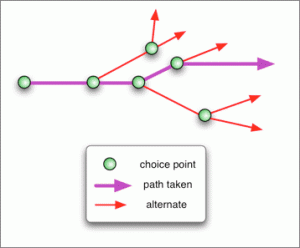
 I’m thinking about what is probably the most common layman understanding of the multiverse, the “parallel universes” theme that frequently shows up in science fiction (e.g. Sliders, select episodes of every Star Trek show ever) and fantasy (e.g. The Chronicles of Narnia). In particular, the two aforementioned science fiction programs employ the idea that upon reaching a choice with two possibilites, both are actually selected, and reality bifurcates, as in the figure above. In fiction, a common plot device is the unusual mechanism (whether technological or supernatural) that allows travel from one world-branch to another. Such a mechanism must be unusual, because we don’t experience such reality shifts in daily life.