
Please read this very inspiring story.
Author Archives: Geoff B.

A few thoughts on the Pew study of religion
The Pew study on religion is a massive undertaking. Pew interviewed 35,000 adults on religious habits in English and Spanish. The study is not perfect, but it seems to be widely recognized as the best, most comprehensive study out there on the religious practices of Americans.
For Mormons, there is some good news but also plenty of worrisome news.
First, the good news. Mormons still have big families.
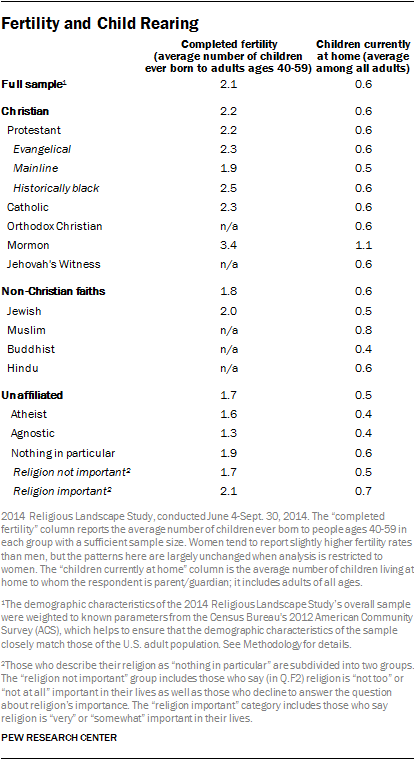
Mormons have significantly more kids than any other religious group. This of course is good news for the future. Kids born Mormons are more likely to stay in the Church.
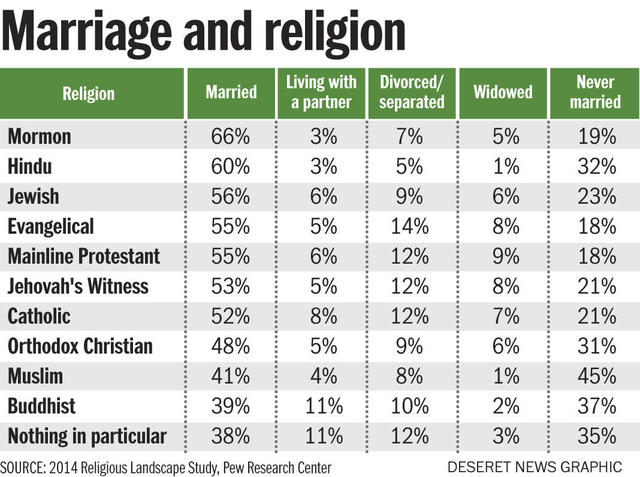
Mormons are also more likely to be married and divorce is relatively rare.
Why you should have more sympathy for protesters in Baltimore and Ferguson
The chaotic protests and looting in Ferguson last year and Baltimore in the last week have created understandable concern about the rule of law in these cities and elsewhere.
Who cannot help but admire the mother who disciplined her teenaged son who she thought was throwing rocks at police?
This mother’s actions seem to show that 1)the people protesting are misguided thugs and 2)all that is needed is a bit of discipline to get things under control.
Such a reaction is understandable but unfortunately ignores the realities of the lives of people in Ferguson and Baltimore and their interactions with the government. Once you begin to dig down into how police and local government have, for years, oppressed the people in Baltimore and Ferguson, you cannot help but feel some sympathy for residents there.
Let me put it to you this way: if you lived in the poorer parts of Ferguson or inner-city Baltimore, chances are you would feel helpless and angry at the police and the government too. Would you riot? Perhaps not, but you would at least understand why other people are protesting.
Before going on, let’s remember how the United States was founded. It was a violent revolution against an oppressive government. History shows clearly that the British government was considerably less oppressive to the majority of people in the colonies than the police and local governments of Ferguson and Baltimore today. It is simply a fact that the vast majority of colonists never had to deal with a British government official. If you were a landowner in Connecticut or New York or Virginia, you might go your entire life without ever seeing a British “oppressor.”
So, why did the colonists rebel? Because of taxes (which were ridiculously low compared to today) and because the British government was denying basic rights to people in the Americas that were granted, for the most part, to people in England. It is true that colonists read about and heard about oppression of other people, but the vast majority of white colonists never suffered any oppression from government themselves. (It is worth remembering that the situation was obviously different for the slaves).
Yet, in an environment of relatively light tyranny, the colonists nevertheless wrote founding documents expressly intended to limit and control police power. The colonists recognized that they had unusual liberty, and they wanted to protect and enlarge liberty for future generations.
Do the people of Ferguson and Baltimore have liberty today? No, they do not.
The Economist discusses young women, missions and education
The Economist magazine has a very interesting article on another side of the surge of young women going on missions. It turns out that as more young women go on missions, fewer are going to college, and the Economist says some people in Utah are concerned about this trend:
KAITLYN BOURNE, a 21-year-old student from Salt Lake City, Utah, recently returned from 18 months as a Mormon missionary in Atlanta, Georgia. Before going on her mission, she was studying a pre-medicine undergraduate degree at the University of Utah with a full scholarship. But when the Mormon church lowered the age at which young women can go on missions from 21 to 19 at the end of 2012, the idea of going consumed her. “It was a huge commitment, a really hard decision,” she says. “But after months of prayer and thinking about it, I realised I had to do it.”
Ms Bourne’s decision was hard—she had to give up her scholarship. Since returning, she has made plans to go back to university, but instead of resuming her pre-medicine course, she plans to study music at the Hawaii branch of Brigham Young, a Mormon university. Such decisions concern many Utahns. In seeking to expand spiritual opportunities for women, they fear that the Church of Jesus Christ of Latter-day Saints may be inadvertently reducing academic ones.
I think this article in the Economist, while thought-provoking, has a fatal flaw: it ignores the biggest crisis in higher education right now, which is that going to a four-year university for a BA degree is increasingly worthless.
April 2015 Conference: Sunday morning session
Pres. Eyring conducts
Pres. Monson presides
MoTab Choir sings: “He Is Risen.”
Invocation: Sister Linda S. Reeves
Choir: “Consider the Lilies.”
President Monson
Seven years since he was sustained as president of the Church. Dedicates and re-dedicates temples. The building of temples is a clear indication of the growth of the Church. 144 temples, five renovated, 13 under construction. This year re-dedicating two temples, and five new temples.
Three new temples:
Ivory Coast
Haiti
Bangkok Thailand
Told story of a troubled missionary. Went to the temple, went to the Celestial Room. Another RM approached him, told him about his own mission. Had enthusiasm for his mission. Landon had served in the same mission. The troubled missionary was helped because of prayer and faith.
“In the temple we can find peace.”
He and his wife will be together again.